
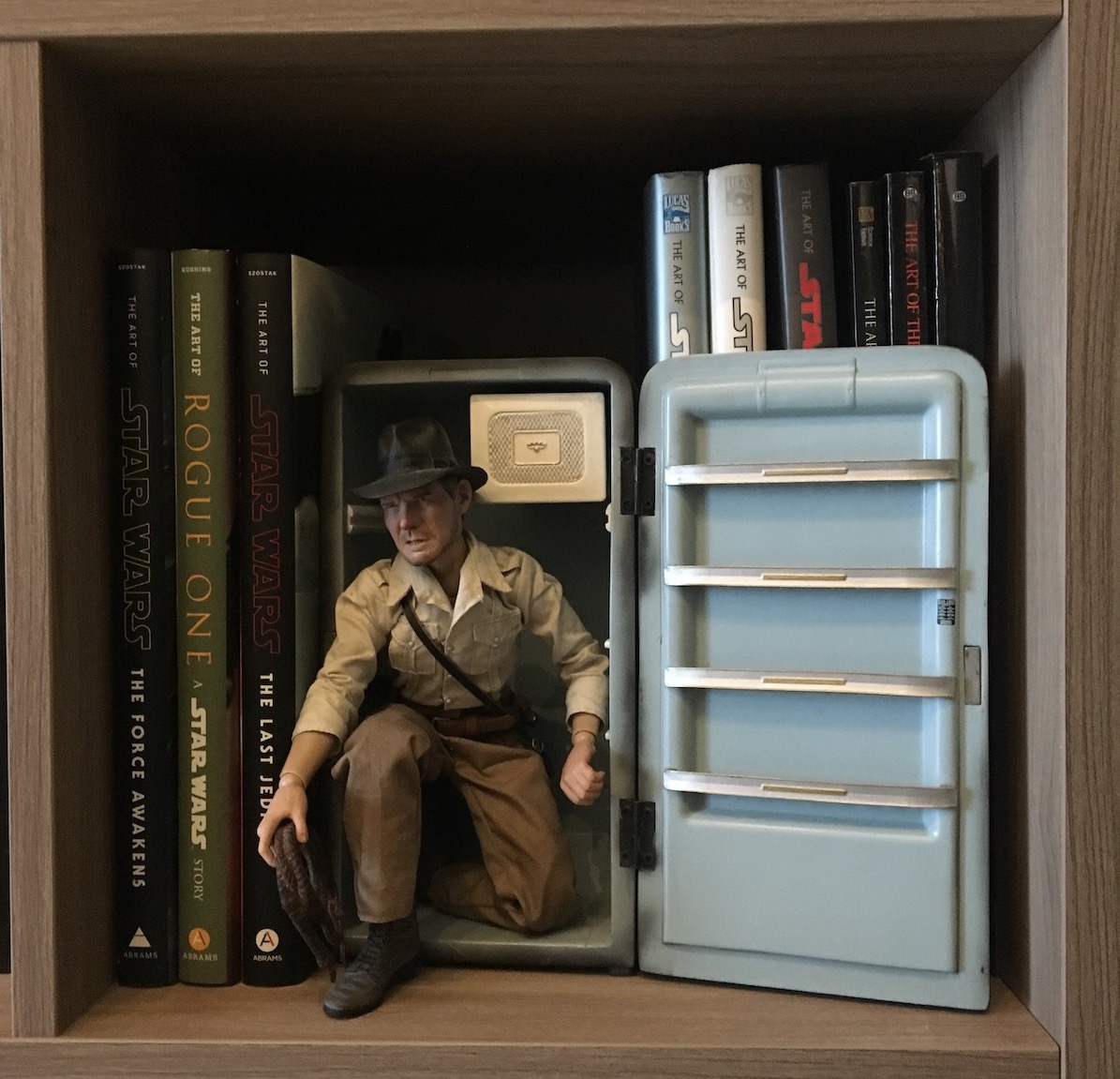
On December 26, 2018, I introduced all four of Steven Spielberg’s Indiana Jones films as part of the Spielberg retrospective at TIFF Bell Lightbox. My remarks for each film are below. Yes: I wore the hat.
Raiders of the Lost Ark
My name is Matthew Brown and I’m the Senior Manager for Web here at TIFF Bell Lightbox. It is my favourite place in the world and I am thrilled to be able to work with this team bringing films like this to audiences like you.
Before we begin, this afternoon’s screening takes place on the treaty territory of the Mississaugas of the Credit, and the traditional territory of the Haudenosaunee, Anishinaabe, and the Huron-Wendat. We are grateful to have the opportunity to work in this community.
How many people are seeing Raiders of the Lost Ark for the first time today?
And how many are staying for all four Indiana Jones films?
We’re showing the vast majority of Steven Spielberg’s films this week and next, which gives you the opportunity to see them on the big screen the way they were intended. Raiders is my all-time favourite Steven Spielberg movie, which is a tough position to hold because I basically love all of them. The programming team was nice enough to let me introduce this screening, although I think they may have done it because they were concerned that if they did not, I would run onto the stage and seize the mic.
Raiders finds Spielberg at a unique point in his career. He had made a critically-successful small movie with The Sugarland Express in 1974, and then followed it with two of the most successful movies of all time, Jaws and Close Encounters of the Third Kind. Then he makes a film that is considered to this day to be his one unqualified commercial and critical disaster: 1941, a comedy about the aftermath of the Pearl Harbour bombing.
So with Raiders, Spielberg is out to prove a point. He wants to prove that is not a wild-child runaway filmmaker. Jaws, Close Encounters and 1941 all went over budget and over schedule; with Raiders, he wants to prove that he can bring a movie in on time, on budget, and that he can limit his directorial excess to only what the picture needs. He has twice as much reason to do this, too, because producing the film is his best friend, George Lucas.
So Raiders is a master class in economy of expression. It’s tight, it’s lean, every shot is purposeful, and it gives itself completely over to Spielberg’s masterful control of the cinematic language: storytelling through composition, and cutting, and sound, and of course John Williams’ brilliant score.
Spielberg did indeed bring the film in under budget and finished shooting several days ahead of schedule. Because Raiders is a mashup of cheap serial pictures from the 1930s, too, Spielberg uses this as an opportunity to make a film where the magic of filmmaking — i.e. the fact that everything is fake — is on fine display if you know where to look for it. He knew that verisiimilitude was NOT necessary for a movie like this, where you’re on the edge of your seat invested in the derring-do of an onscreen adventurer. In fact, Raiders is one of the greatest going-along-with-it movies of all time, containing two of the largest plot holes of any major motion picture, which you completely ignore because of the film’s propulsive forward movement.
I hope you all enjoy it; Temple of Doom starts at 3:40 if you’re staying. I will see you then.
Indiana Jones and the Temple of Doom
So: Indiana Jones and the Temple of Doom. The notorious Indiana Jones and the Temple of Doom. The only movie in the Indiana Jones series that Spielberg himself disavowed. He claimed after the fact to have misjudged how dark and mean Temple of Doom is; he prefers Indiana Jones movies that are light and charming and possibly weightless.
I disagree. I think Temple of Doom is a terrific sequel to Raiders, even given how over-the-top ludicrous it frequently is. It is darker and meaner, but to mesmerizing onscreen effect; the film of course contains a famous roller coaster sequence but the entire movie, as an emotional experience, is the biggest, scariest roller coaster you’ve ever been on. I first saw the film illicitly at a friend’s birthday party and I don’t think I slept for a month. It’s worth noting that both Spielberg and Lucas were going through marital troubles when they conceived and made this movie; in fact Lucas was going through a divorce. This is two angry men in their thirties venting their spleen and I am here for it.
The film earned the ire of parents groups when it was released and led to the creation of the PG-13 rating by the MPAA because of its not-quite-PG, not-quite-R levels of violence. George Lucas felt the title was warning enough; he was heard to remark, “it’s not called Indiana Jones and the Temple of Puppies.” I myself have always been fascinated by the idea that this group of people in the film had come together to design and build a temple devoted solely to the study and worship of Doom. Most temples are about much nicer, sunnier things; these guys must have really felt like they were ahead of the curve. “What can Doom teach us?”
Something else Spielberg may have regretted later was the film’s overt racism. With Raiders, Spielberg and Lucas were repurposing the 1930s serials and with Temple they get even more specific, essentially doing a remake of the 1939 picture, Gunga Din. Has anyone seen Gunga Din?
Gunga Din is great, it’s well worth seeking out, an adaptation of the Rudyard Kipling poem of the same name, but it is 100% a colonialist narrative about white men on an adventure in the furthest reaches of the Indian subcontinent where they encounter a Thuggee death cult and save the day as Kipling must have presumed only white men can do.
Temple of Doom is frequently a shot-by-shot recreation of Gunga Din, and we must presume that it never would have occurred to Lucas or Spielberg that remaking colonialist narratives from almost a century earlier might contain some less-than-desirable racial ideas. Colonial narratives, of course, are at the base of the entire Indiana Jones concept, so it becomes harder and harder to get away from this stuff no matter what you do. The first film opens with him raiding the sacred temple of an indigenous people, stealing their golden idol, and running away.
You have to ignore a lot to enjoy Temple of Doom for its over-the-top sensual pleasures, like the dining sequence at Pankot Palace or the creepy-crawlies scene that follows which, for my money, is the best in the series, putting the snakes in Raiders to shame.
I’m also a huge fan of Short Round, Indy’s sidekick this time around. He’s played by Jonathan Ke Quan and here we can really see the Spielberg narrative take over; he’s a young kid on an outsize adventure making it up as he goes along, learning from his mentor Indy, and saving the day more than once (or even twice). Williams even writes Shorty his own theme for the score, which is second only to Indy’s in the overall composition. They are working on an Indy 5 right now and that’s great, but if it were up to me, Indy 5 would be about Short Round, Short Round’s adventuring kids perhaps, and only tangentially about 75-year-old Indiana Jones.
Enjoy the film!
Indiana Jones and the Last Crusade
So, with Last Crusade, Spielberg wants to return to the sunny, adventure-over-the-top-of-the-earth style of Raiders of the Lost Ark and away from the underground black magic of Temple of Doom. At this point in his career he also, it should be noted, wants to get away from this kind of movie altogether. He wants to make serious films. He’s just made The Colour Purple and Empire of the Sun and he’s on the way to making Schindler’s List, and he’s always considered himself a serious filmmaker and that all the blockbuster entertainments were just a kind of detour. He calms down on that after he’s won his Oscar and continues to make both kinds of pictures to this day, but at this point, he wants out.
He made a deal with Lucas to make three Indiana Jones pictures and he wants to honour that, but he intends for this to be his last and he wants to make sure it’s something he can, and I quote, “stand naked on top of” after Temple of Doom.
This means for all intents and purposes remaking Raiders of the Lost Ark: there’s an artifact, and competing teams of people trying to find it; there are Nazis, and we get to punch Nazis, and boy it’s great to punch Nazis, and boy is it troubling that we’ve survived to an era where there are actually people in the world who would hold up their finger and say “Hang on now — should we punch Nazis?”
Yes. The answer is yes. Always punch Nazis.
The most famous innovation in this picture is Sean Connery as Indy’s dad which supplies the lion’s share of the charm and, let’s face it, the hotness (Connery is only 14 years older than Ford, so if you’ve got a silver fox thing, this is your movie.) But I think it’s also worth paying attention to Alison Doody’s character in this one.
She plays Dr. Elsa Schneider and for the sake of anyone who might be seeing this the first time I won’t say much more but consider the degree to which Elsa is in many ways a third iteration on the Indy / Belloq mold, except this time, she’s female. She makes a lot of the same choices we’ve seen Indy make in the other pictures but there’s a manner in which the audience is meant to feel about her that we never felt about him, arguably because she’s a woman. Spielberg made what he thought was a well-meaning joke about a female Indiana Jones earlier this year but with Elsa, he found her 30 years ago, and maybe didn’t notice what he had.
Enjoy the film and if you’re staying for The Kingdom of the Crystal Skull, first of all god bless you, and second of all it starts at 9:15.
Indiana Jones and the Kingdom of the Crystal Skull
So in spite of Last Crusade literally ending with Indiana Jones riding off into the sunset and Spielberg and Ford both proclaiming publicly that it would be the last of the films for them, a few years later… rumours get started about a fourth Indiana Jones movie. It takes them 18 years to get there, during which time they go through an ungodly number of screenwriters. M. Night Shyamalan wrote a draft shortly after The Sixth Sense; Frank Darabont also did one; he created The Walking Dead for television, and also wrote the best episode of the Young Indiana Jones Chronicles, “Young Indiana Jones and the Phantom Train of Doom.” Darabont’s script took a lot of its cues from the Humphrey Bogart / Katharine Hepburn film The African Queen, which we’re playing at the Lightbox on March 3rd by the way. It’s a smart way to approach an Amazon adventure for an older Indy and Marion, and does a much better job writing Marion than Crystal Skull’s script eventually does, so seek out that script if you can.
But I’m not here to condemn Crystal Skull. There are some truly striking images, particularly in the first act, when Indy mounts a ridge and is confronted with an expanding mushroom cloud from a nuclear test site; in fact, the entire first act is nicely laced with comments and throughlines about a very fundamental question, which is: has the world left Indiana Jones behind, and how does Indy feel about all the blank spaces on the map being filled in.
This is what makes the ultimate source of the film’s treasure — the crystal skulls — a cannier idea than focusing on the traditional earthly treasures of the previous films, because it proves that the map is never filled in; you just need to get a bigger map.
We see a lot — and I mean a LOT — of this type of movie nowadays, the long-after-the-fact restart of a franchise that ended in the 1980s or 1990s. Jurassic World. The Force Awakens. Creed. Ghostbusters. The ones that work, like Creed or The Last Jedi, work because they don’t just exhume a long-dead series; they do something with those stories that gives meaning and weight to those stories while also having meaning and weight of their own.
Unfortunately Crystal Skull leaves a lot of that collateral on the table after the first act, but there’s still a lot of fun to be had, especially with Ford, who gives his best performance in well over a decade as a 60-year-old, cantankerous, tough-as-nails Indiana Jones. He had sleepwalked through a lot of his career up to this point so it was refreshing and fun to see this Harrison Ford come out for one last crack of the bullwhip.