Last week I bought one of those stainless-steel reusable filters for my aeropress, figuring it’s generally better to get into reusables than to keep burning through paper products ad infinitum. And I’ve been an Aeropress girl for I’unno, a decade now, so that ad is definitely approaching infinitum.
Anyway that god damned filter was a disaster from day one, the water and the coffee just exploded through it at the top of the brew period, usually all over my counter and/or me. I did something I am only hesitantly starting to do ever since Google got turned over to A.I., which is that I went looking on Reddit for what other humans have to say about this problem.
Well, I found the thread and I found my problem and I found the other people like me discussing it, and then I found the guy, the sage, the Zen master in the wild, and his single-line response: “You could always just brew inverted.”
Ain’t it like that sometimes.
A better hang
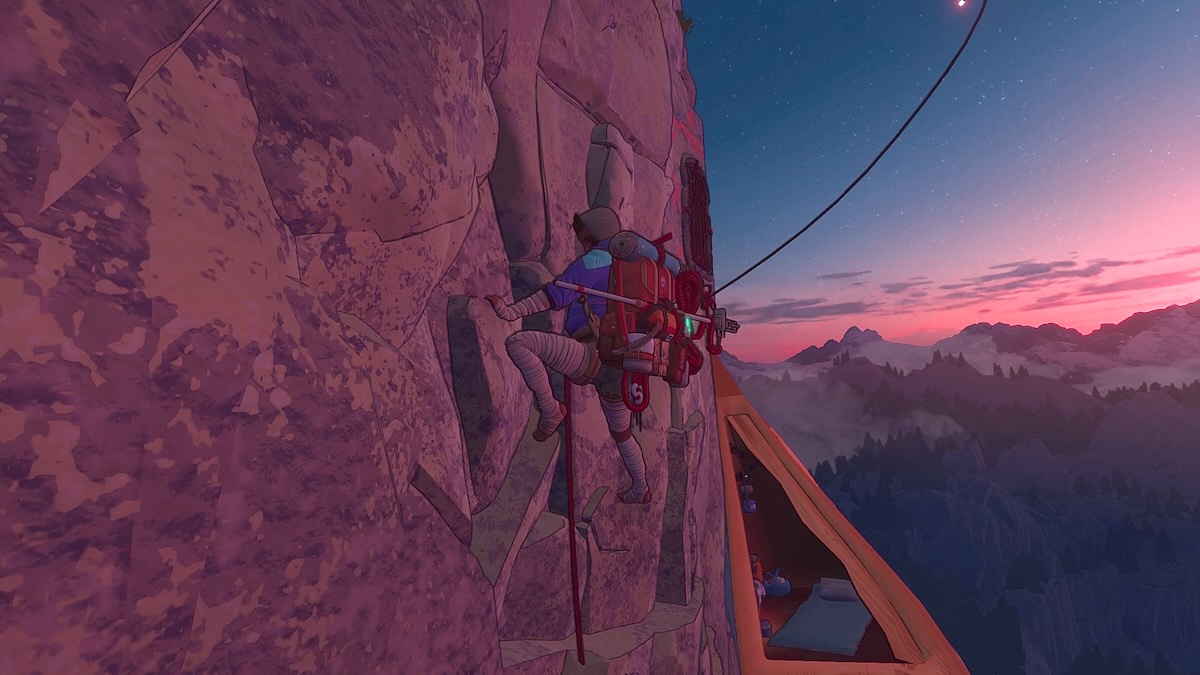
Long story short, I wasn’t allowed to read last week, so among all the other ways I radically amped up my screentime in response (definitely not the point of the exercise), I got deep into Cairn, the new mountain climbing sim game from the Game Bakers. Building on what I had to say about Tetris last week… well, two things.
1/ Given the rather high stress level of playing a game where you position a mountain climber’s limbs one by one and thus inch your way up an unassailable peak, it’s nuts how meditative I’m finding this experience.
2/ Given that… does Cairn fall into cozy gaming?
I admit I’m not too versatile on gaming definitions other than “I’ll know it when I see it” and for me, cozy gaming examples would be, like, the non-apocalyptic elements of the Life is Strange franchise, or any game where you run a konbini.
And it feels a bit counterintuitive to find coziness in hanging hundreds of feet in the digital sky, from fingers that are starting to bleed as all of my limbs shake. But, every time Aava (the player character) gets to a new milestone in the climb, we do (she and I) get to squat in our tent and cook something. There’s also relatively little music, plenty of open-air vibes, and the skies are divine, even when it’s raining. I dunno man. The whole thing is making me wonder if I should locate actual muscles somewhere in my body and then try mountain climbing for real, except there, I bet when you fall hundreds of feet (as I do frequently) you probably don’t get to start over.
Coziness, though, is in. Coming out of the wintery hell we just went through (it’s not over, but I digress), I’m wondering if we’re all on maximum-berserk coziness seeking. On which note, look who’s been pulling in 13 million viewers a week:

Ira Parker’s adaptation of A Knight of the Seven Kingdoms isn’t just (with a few asterisks) the most well-rounded and overall compelling George R.R. Martin adaptation yet. It’s also just… a good hang. A cozy vibe. And audiences clearly wanted that.
(The asterisks go to the obvious unfairness of comparing a four-hour single season against a blockbuster television program that had to run twenty times longer than that.)
AKOT7K is, more mercenarily, another attempt by HBO to build out Game of Thrones as long-running IP beyond its progenitor television series. This, as you might have noticed, is the game that everyone is running, these days. There are no new stories; just people trying to burrow into the existing frameworks of existing stories. Which raises, I think, some interesting questions about what types of audiences want what types of exploitations, from their IP of choice.
Here’s something via E. Alex Jung, which caught my eye this week:
There are, broadly, two kinds of fans: the affirmational and the transformational. (They can overlap.) The affirmational fan is the one who obsesses over the facts, details, and rules of a given world. They are the originalists of what is “canon,” and the foot soldiers of the author, who is always right.
The transformational fan is the one who identifies a crack within the text to fix or to insert their own desires. “It’s largely a democracy of taste,” writes obsession_inc, who first put forth this framework. “Everyone has their own shot at declaring what the source material means and at radically reinterpreting it.”
(That’s from a larger narrative history of slash fiction and fan fiction, itself only a component of Jung’s “wow the gay hockey show got real popular huh” piece, all of which is worth reading.)
Longtime readers might be aware that a lot of my hesitation around someone like, say, Lucasfilm CEO Dave Filoni — or even the racist yobs who whine about Dwarven skin colour in various Rings of Power subreddits — is that they are what I call loremasters, and I find loremasters very dull. (Ask me sometime about the guy who buttonholed me at a party once, and complained to me for two unbroken hours about everything Christopher Nolan’s Batman Begins gets wrong about Batman.)
Loremasters think they’ve found the hidden cheat code to the universe and/or (Andor!) the imaginarium in question, and because they tend to be on the “art is objective” side of the objective/subjective divide, they’re gonna tell you about what they think are the Rules, and why they think they’ve been broken. Which — as anyone who’s ever actually attempted creative work in anything like a long term will tell you — aren’t even the rules, inasmuch as there even are rules, which, by the way, there are not.
Moreoever, I find loremasters uninteresting and incurious. I’m personally much more interested in what a transformationalist interpreting a work wants to do with the crack they’ve prised open, because that way lies synthesis — the opportunity to articulate something unique that both includes and extends the scaffolding of the original artwork — rather than a mere acknowledgment that the original artwork was pretty rad. Hey: it probably was. But also — and to bring it back to where I began:
this is where the vibes are.
A Knight of the Seven Kingdoms, then, is a vibes-based show set within the larger mythology of the Game of Thrones world. It’s inextricable from the latter — it can only work, can only tell its story, with at least passing deference to the rules and established dynamics of that world — but it has a license to hang that the plotty original series could never write itself. (See also: Wonder Man.)
Which is not to say plot is the enemy; Andor is as plotty a transformational adaptive work as one can imagine, but its vibes are immaculate. It’s a show with a feel, as it drills down into that crack between two lines in the opening crawl of Star Wars.
Plot, anyone can do plot. But that feel — that sense of the good hang, the cozy game — is gossamer, vanishing before the rising sun.
Trinity is my Robby

Speaking of good hangs: it’s come to my attention that there are a lot of people in The Pitt fandom who hate Trinity, and to them I can only say, I hate you with a zealotry that would unsettle your ancestors’ dust.
To be fair, Trinity’s probably a terrible hang, at least in terms of “people to invite to the party.” But then: so am I.
In The Pitt‘s hierarchy of lost and broken healers, there is Everyone’s Favourite — Dr. Michael “Robby” Rabinovitch, played in fuck-me eyeglasses and fuck-me-harder hoodies by the exquisite triple-threat Noah Wyle — a character so beloved that his not wearing a motorcycle helmet in the early seconds of this season has sparked two months of concerned discussion.
And then after Robby, there are half a dozen candidates for next-most-broken (Dr. Jack Abbot spends his off-hours getting into gunfights as part of a SWAT team?!), but my MVP broken girlie has been, is, and ever shall be, Dr. Trinity Santos.
I’m sure there’s no small amount of gender bias in the fact that Trinity, who is equally damaged and fucked up, is disliked where Robby is loved. (For another example, see this season’s new addition, Dr. Al-Hashimi.) I’m not really going to drill down on that; people are going to do what people are going to do.
And Trinity is a jerk. She’s a clearly wounded, deeply uncertain jerk; but she’s a jerk. (Robby is also a jerk. He’s a jerk in different ways — he doesn’t assign cruel nicknames — but he is definitely a shitty boss, mentor, and friend, a non-zero amount of the time. For the example here: see Dr. Langdon.) The show seems aware that both Trinity and Robby are equal-scale jerks; in last week’s episode, the jerks even shared a critical scene, united in jerkdom, where they wax poetic about protecting their “fucking Huckleberry” (Dr. Whitaker) because while Trinity and Robby are both jerks, they are jerks who will go absolutely feral if you fuck with one of their people.
And here is where I come in again.
Aside from the fact that she’s as pleasant-on-the-eyes as any other Pitt character (and if you don’t think lust is a factor as we’re making our teams here, well, go on Reddit for an hour), Trinity’s my favourite because of how much I see of myself in her… and not, in most ways, the good parts. I kind of like that. I kind of like that Trinity is the exact kind of asshole I’m fully capable of being, and that it causes her trouble in some cases but is moreover just a strategy that has clearly worked to a point, to allow her to navigate her own shit. We all have shit: relax about it. But here’s the thing they never really tell you about this when they give you the handbook on being alive: strategies that let you get by might get you only as high as the water mark of getting by, and no further.
My suspicions that our Trinity is about to learn all that, in season two of The Pitt, were already on max sensitivity back when she was non-reacting to her girlfriend spacing on her a little bit. Now that Trinity’s revealing her self-mutilation scars (to us, the audience, only), I am on red fucking alert.
(btw Garcia, who seems like a good surgeon and can walk off a knife in the foot like nobody’s business, must nonetheless be a pretty shit doctor and a shit girlfriend if she hasn’t noticed, at any point when she and Santos are all raw and wrigglin’, that Trinity is self-harming.)
The good news is that enough people seem to love Trinity, myself included — Robby and definitely Whitaker and mayyyyybe even Langdon if we’re being optimistic, are going to go to bat for that kid because see above, re: absolutely feral. Sure, that kind of protectiveness is its own kind of dysregulation — again, ask me all about it sometime — but they’ve all got it. And I hope we’re gonna see them use it.
The Five Elevens
Friend of the blewslettorg Dr. Rajo Zakic came calling last week and brought with him a rather nifty 3 3/4″ Eleven action figure from Stranger Things 5.

Rajo didn’t know that I’ve had an overall plan to build a five-part collection, with one Eleven from each season of the show. But I have, and now, I do. Borrowing an idea from my brother’s Chewbacca collection, I like the range of art styles, the last ten years of fan collectibles in microcosm. Funko Pop, MacFarlane, the “art statue” from Weta and the strong anime styling of QPosket… and now, for some reason, a retro throwback 3 3/4-incher straight outta the Upside-Down, complete with bottle of juice. I couldn’t have planned this better myself.
Speaking of Netflix: I have a question.
Forgive me, but one of the better things about an old job I had was that the organization for which I worked had a particularly well-articulated scheme for the advancement of its team members. Meaning, the rules and guidelines were very clear (ha ha! loremasters!), regarding what one had to do to move from one role to another, or one level of responsibility to the next.
A key tenet was that you had to demonstrate competence in one role before you could be vaulted to another one. So while people are lobbing questions back and forth about whether it’s better for Warner Brothers / Hollywood / film as an art form / life on planet Earth for Netflix to buy Warner Brothers, or for Paramount to buy Warner Brothers — the latter, a question that won’t die thanks to a petulant, walking slab of marble who, at best, falls under “the acquiescent” in my nominal rejoinder of “fuck the acquiescent” — the question I’d like answered is this:
Why aren’t we looking at whether David Ellison can effectively run one major studio, before saddling him up with two?
Didn’t he buy Paramount in, like, September? Didn’t he lay off a gajillion people the moment he got there? Didn’t he lose Tyler Sheridan immediately? Isn’t Paramount+ still the worst-ranked major streamer? Isn’t Mission: Impossible over? Doesn’t Paramount, as a studio, whether under Lansing or Ellison or anyone else, have an enormous amount of work to do to return to market viability, without the added burdens of absorbing a whole second business?