
Science fiction should be, at least in part, about how we imagine the future. Never has the future struggled to be born more than in Starfleet Academy, which is set in the 31st century, but wherein the 31st century sure seems a lot like Now (But It’s Star Trek).
Let’s dive into it.
In the 31st century…
Starfleet Academy is currently the only Star Trek series airing. It replaces Star Trek: Strange New Worlds, which was a “get the band together” prequel to the Original Series, and explained to the fandom how and why Kirk, Spock, Uhura, Scotty, Sulu, and Bones ended up on the Starship Enterprise together. (Spoiler: they were assigned there, as part of their duties in a military organization.)
Starfleet Academy is also a sequel to Star Trek: Discovery, the first NuTrek (the colloquial term for modern, i.e. post 2010, Star Trek) television series. Discovery went through such bonkers narrative convolutions that although it debuted as a prequel to the Original Series as well, it ended up set in the 31st century (i.e., 800 years after the Original Series).
In that time period, Starfleet has been obliterated and is in the process of being rebuilt. Hence: they need an Academy, to make new Starfleet people.
You can take or leave Starfleet Academy. I’m not really here to assess it as a television series. For one thing, it’s much too early: as of this writing, we’re 5 episodes in, and one can no sooner smile at “okay pilot, disastrous second episode” before remembering that Star Trek series always go like this. The Stars Trek tend to take a good bit of shakedown time to get up to speed; it’s like in Star Trek: The Motion Picture when they turn on the warp drive for the first time and everything goes kablooey. (Or the transporters randomly melt people.) (That movie’s a whole nest of metaphors for what it’s like to start a Star Trek thing, now that I’m thinking about it.)
I want to say, too, that the central tenet of Starfleet Academy‘s adaptation of Star Trek — we’re doing YA in space, y’all! — is pretty on-the-mark for this moment. I like it. The series plays like a cross between Fourth Wing‘s intra-college wargaming and Heated Rivalry‘s interest in watching exceptionally hot people be hot (and kiss). There are all kinds of folks on the internet who are ready to dismiss Starfleet Academy for those elements alone; to those people, I quote Bill Shatner. Get a life.
But there’s no avoiding the fact that like all the live-action NuTrek before it, Starfleet Academy imagines a future that is implicitly violent and nihilistic. Like a lot of NuTrek, it is quick to pay lip service to the presumed Star Trek ideals of optimism and working together; like a lot of NuTrek, it also frequently belies the hollowness of that lip service, because everything about how it visualizes its future speaks to the opposite of a better world.
In the series’ pilot episode, mothers are ripped from children, impassive judiciaries refuse to hear the please of the disenfranchised, and bad-faith actors work “the system” against itself to achieve cruel ends. (It’s all a bit on-model for the January in which it debuted, IMHO, though I guess the writers had no idea what would be happening in the Zone of Interest next door, when these episodes started to air.)
The future looks like this:
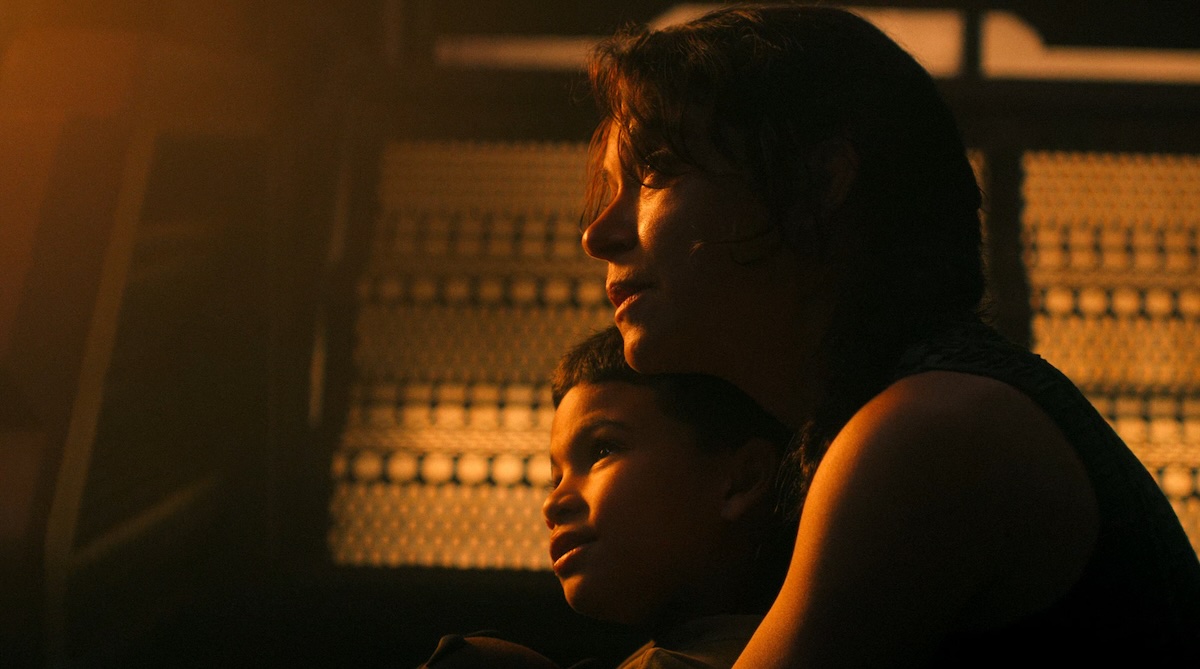
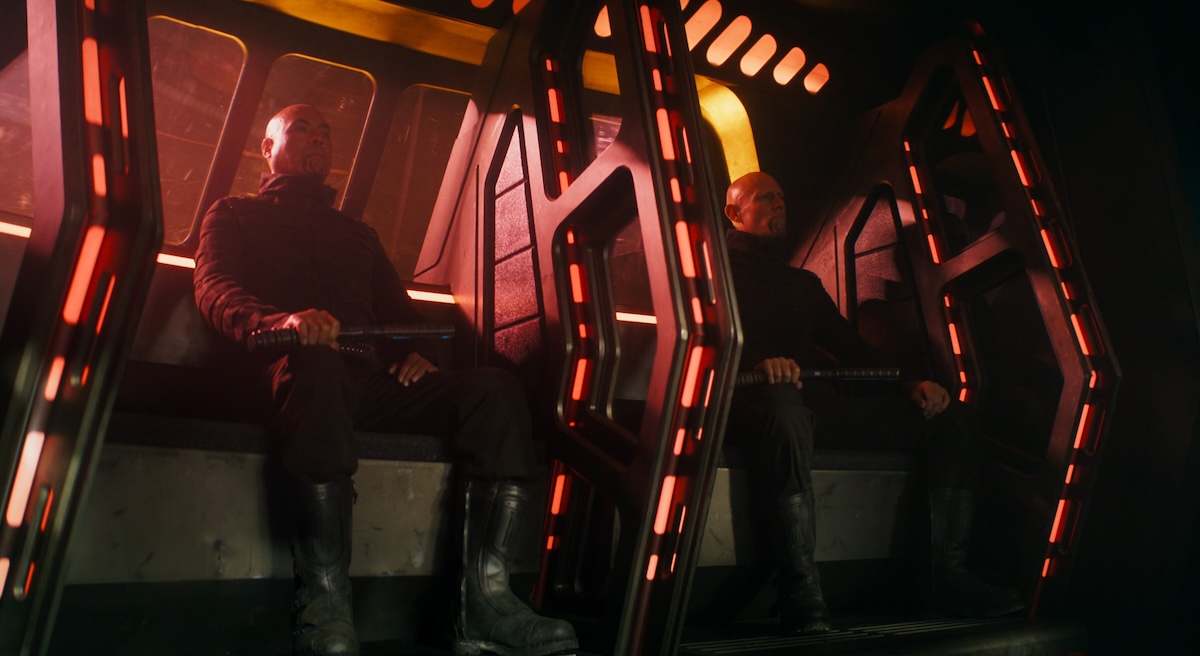
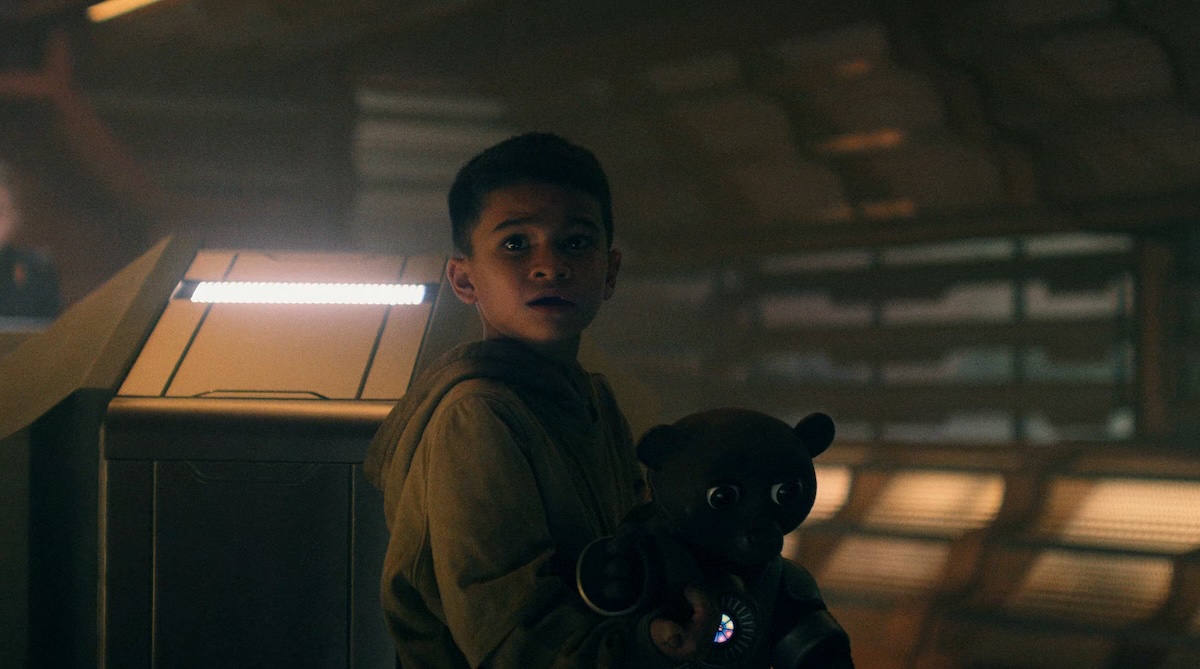
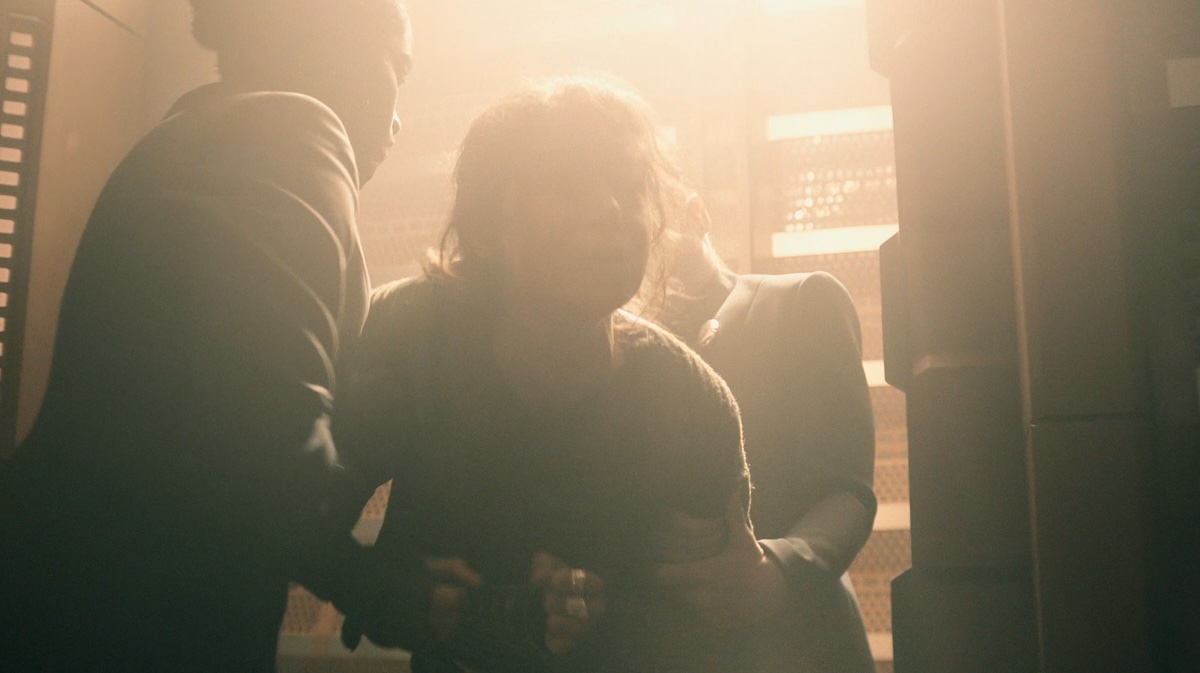
So far, so pro forma. The series imagines a lawless frontier on the edge of Federation space where chaos rules and “life” is eked out cautiously, against overwhelming resistance. The images are baroque; emotional. They emphasize the helplessness of the (heaven-lit) “hero” characters against the ironmongery of the (hell-lit) “system/world.”
Then, someone flips on a light switch, and we’re here:
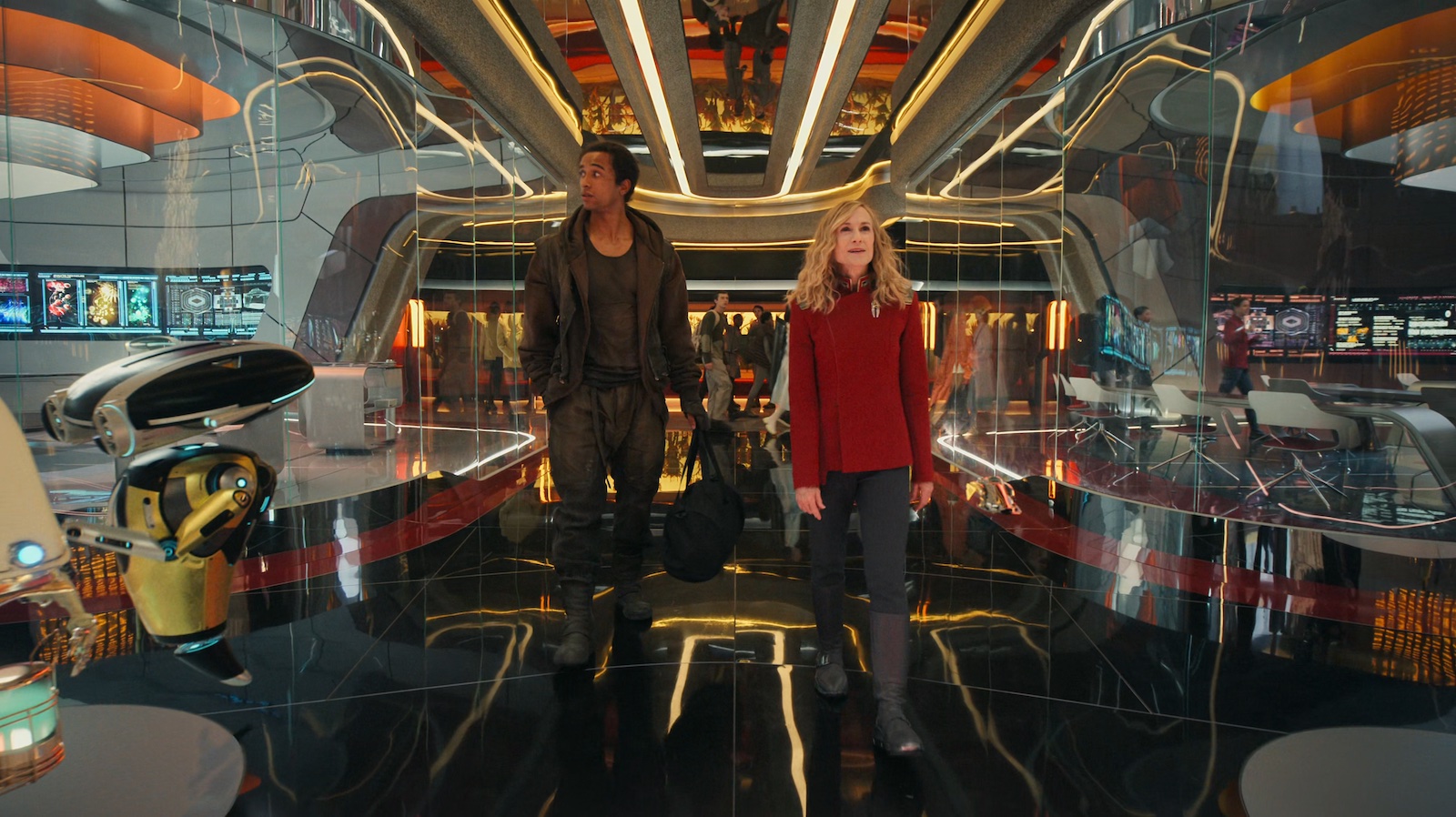
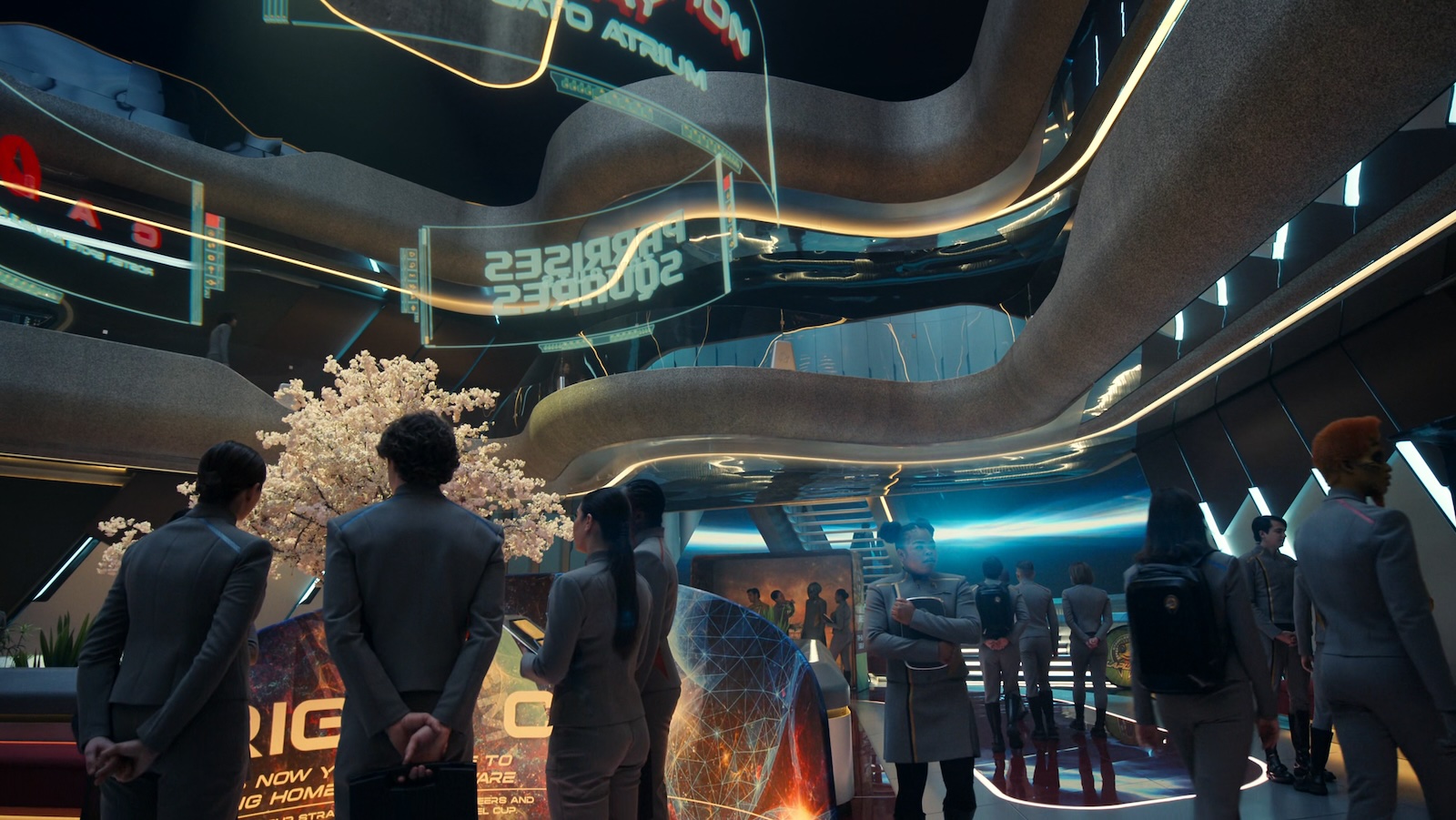
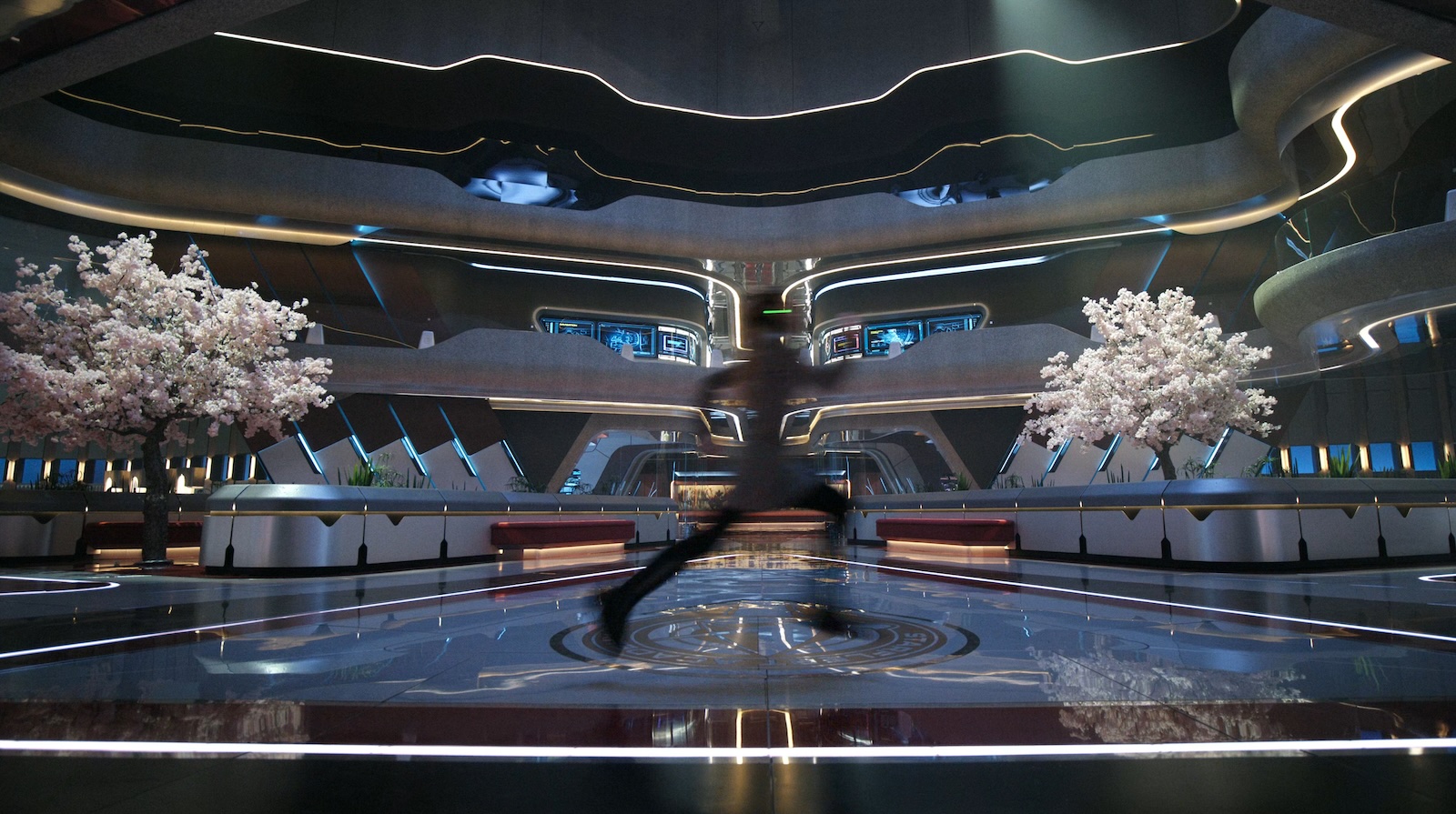
Our two protagonists, Caleb Mir (Sandro Rosta) and his teacher (Holly Hunter), have made a gentlepersons’ agreement to take up with Starfleet Academy. The pressure of the universe at large is replaced by the pressure of the close environment, as they walk a futurized campus quad so ram-packed with visual overwhelm that it seems designed to cause photosensitivity seizures. Holograms are holoprojecting. (One of them is doing opera from the mezzanine.) Attention is being siphoned in every direction. Stephen Colbert is talking all the time and occasionally doing dick jokes. Shrouds of holographic data surround the characters (upon request and also not upon request).
It’s a gorgeous set. It’s a gorgeous set. The people who built this thing should be proud as hell. This fully immersive, multi-level monstrosity — the Toronto Reference Library, if it was made out of iPhones with “liquid glass” dialed up to eleven — is (within the narrative of the show) the central hub of a spaceship saucer section that is also the main campus building of Starfleet Academy, which means that it can be both exploring the stars and sitting in San Francisco, being a school*.
*This, to me, charmingly recalls the introduction of the USS Defiant on Star Trek: Deep Space Nine, a series which had been theretofore bound to its stationary space station but faced too much resistance from Star Trek die-hards who objected to its not being able to “boldly go.” Starfleet Academy should just be set at the Academy, no? Why does the Academy need to fly?
I give kudos to the set design because it really is a fantastic piece of physical production that I’m fairly confident followed its own creative brief. It’s the brief I have problems with. The whole visual experience of the Academy proposes that the violence and nihilism of the lawless frontier, in which we begin the series, has not been escaped so much as internalized:
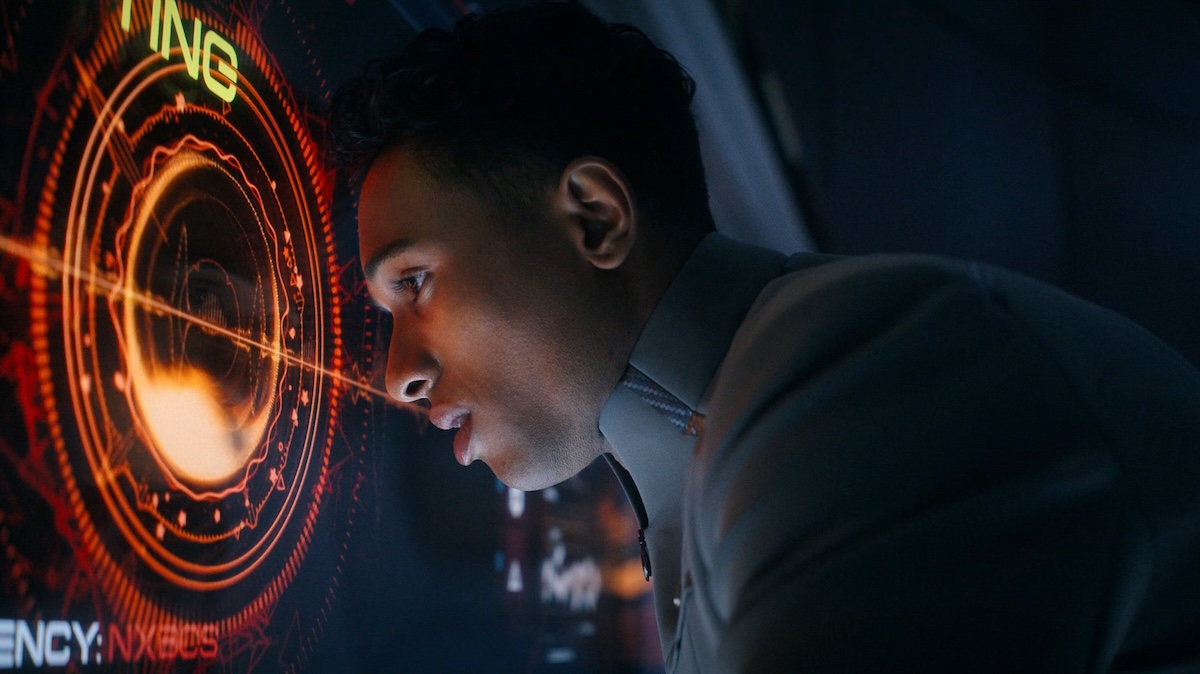
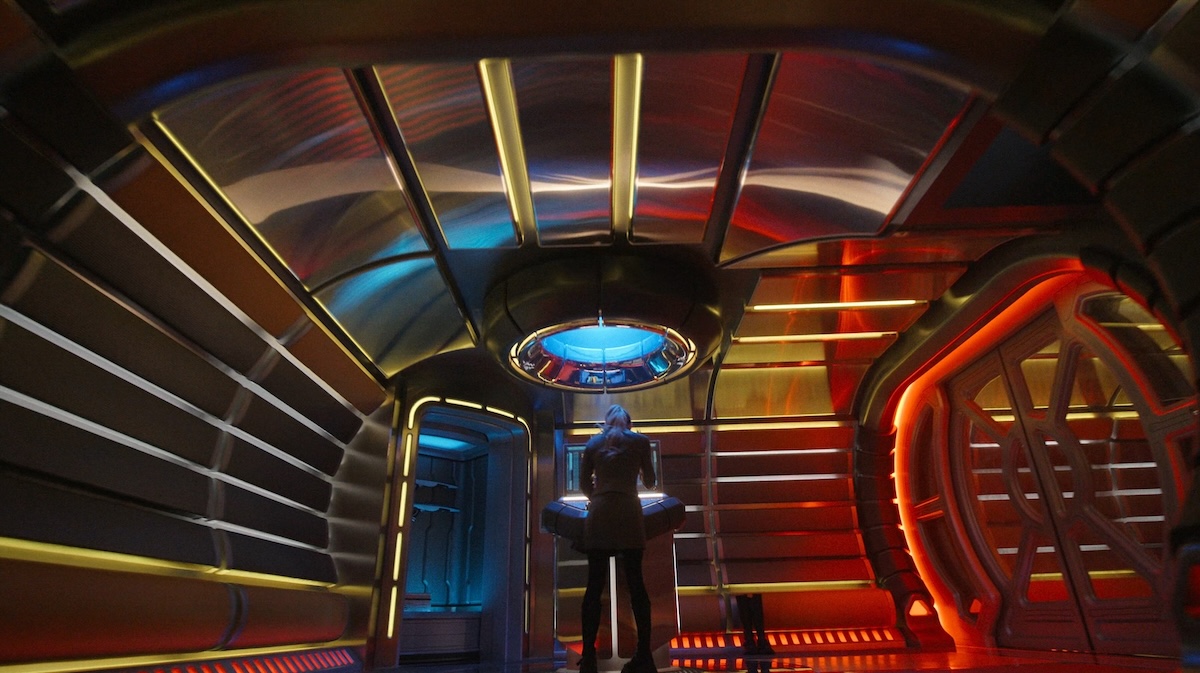
The aching reds of Caleb’s home with his mother return in gargantuan, pulsing radar signals as he searches for her at the edge of space. The State’s violent machinery returns as soon as the Academy goes into red alert and suddenly, heroic Genesis is dwarfed by a massive metal environment in which she is a fragile dot.
And the screens, my god.
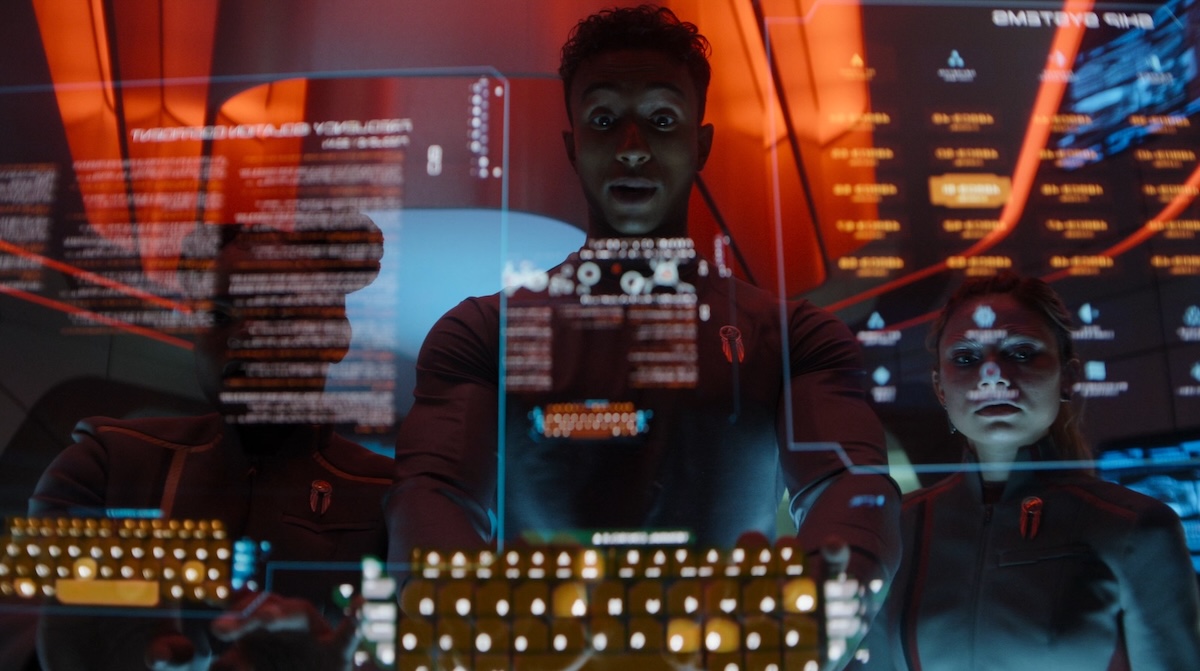
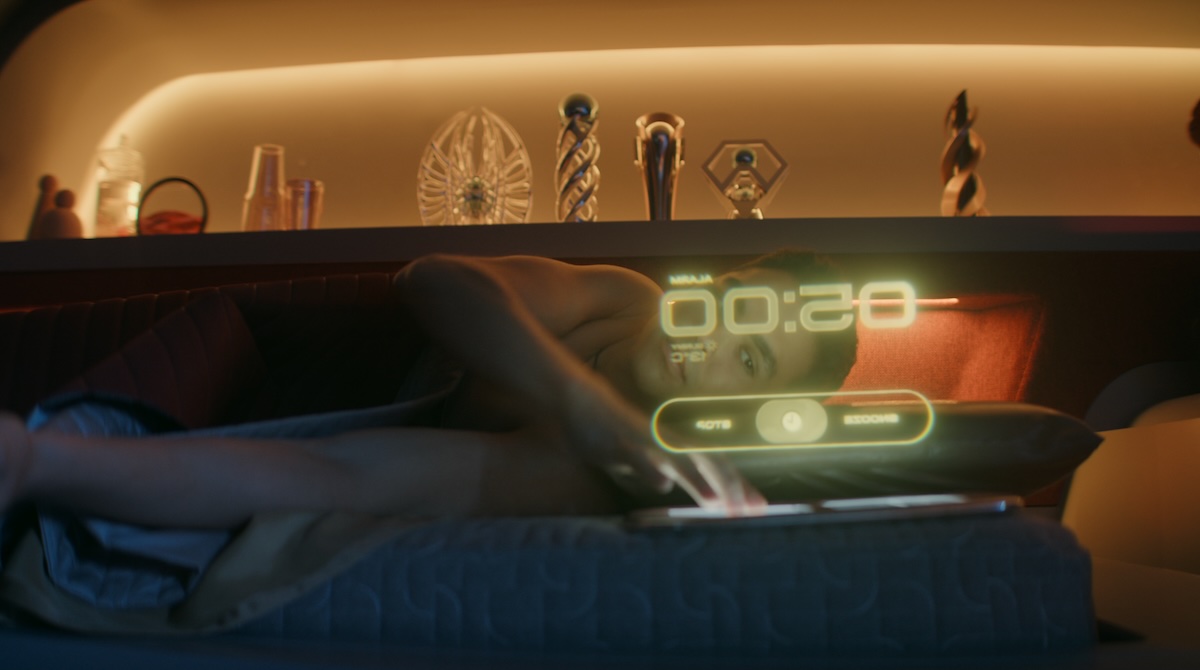
If you were ever of the opinion that our current cultural fixation with staring into phone screens is a big part of why we’ve lost touch with our baseline humanity, rest assured: in NuTrek’s idea of the future, it’s going to get much, much worse**.
**I’m not an idiot: I know this is a pretty decent prediction, re: our relationship to technology. I do, however, question how this qualifies as a depiction of utopia.
Oh: while I was having fun snapping chaotic screenshots, here’s Genesis growing a foot across a single cut:
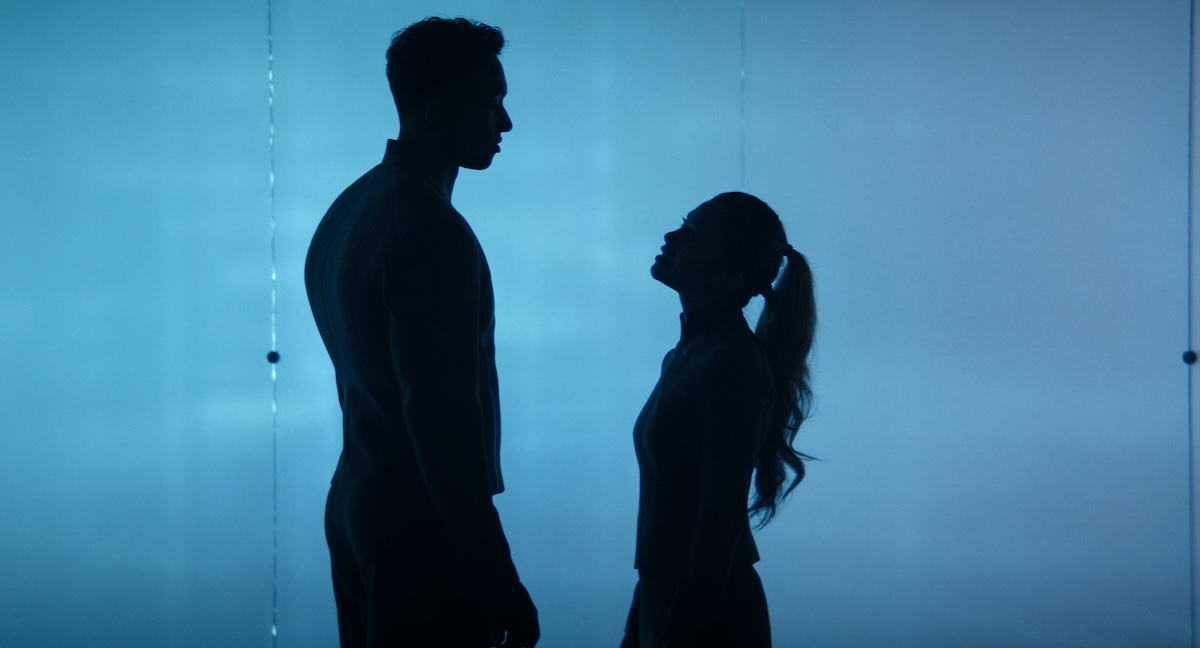
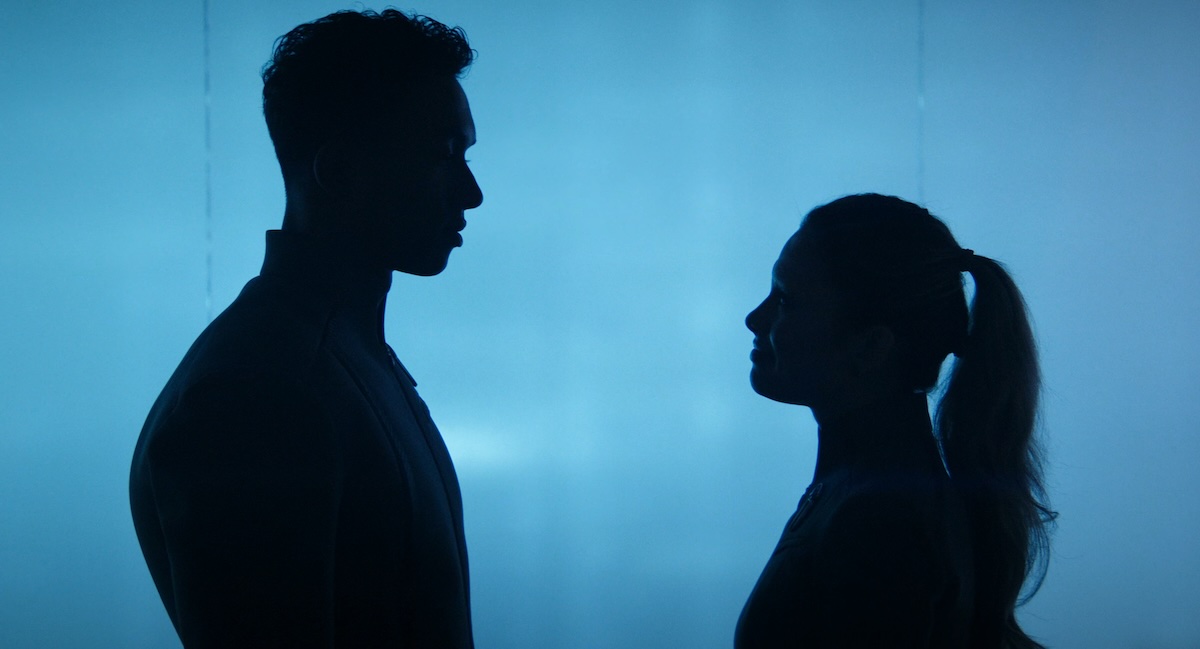
That’s not about anything. It just amused me. For some reason, this series ended up casting several really, really tall people against several really, really short people. It’s quite the compositional dilemma.
I’ll also mention that the young cast on Starfleet Academy is punching above their weight, given both the material and the apparent production requirement that they all be star-fuckingly gorgeous. Bella Shepard is doing good work, anchoring the core student group with a measured presence that grounds the more out-there castmates. For an example of the latter: Kerrice Brooks, an absolute walking charm offensive as SAM.
I’d be remiss, however, if I did not mention the series’ actual avatar of chaos, which is Holly Hunter sitting in a chair:
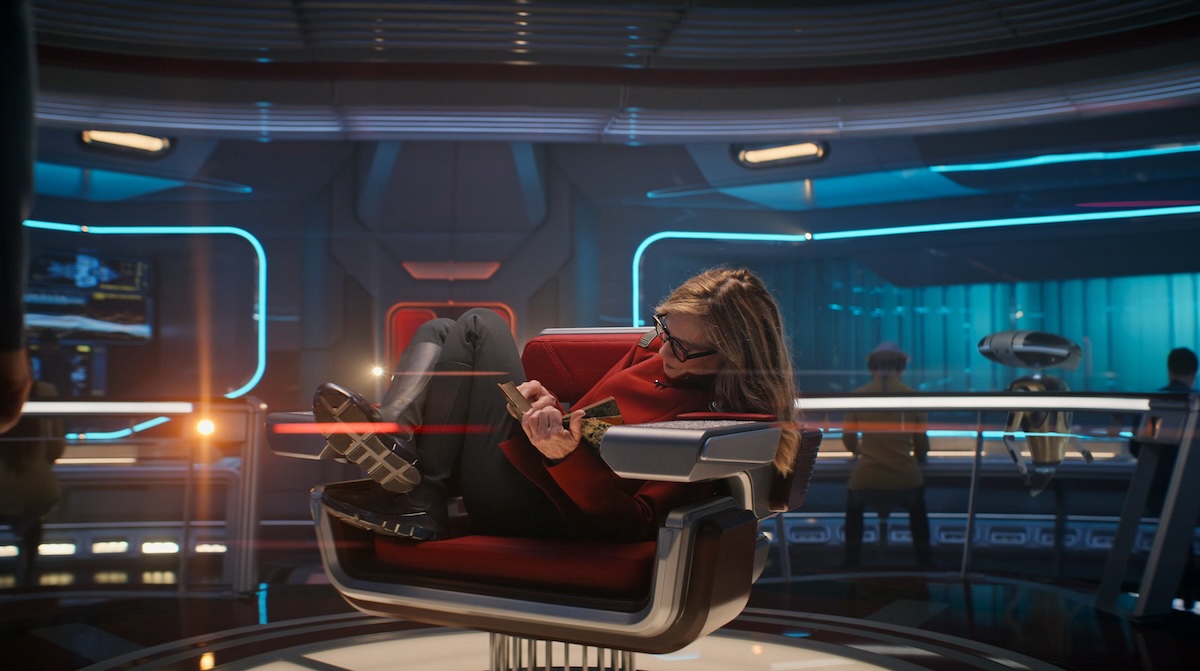
It’s usually down to Hunter’s Chancellor Ake to deliver the (verbal) moral framing in which Star Trek theoretically operates. For example: “Democracy doesn’t live in a place, it lives in continued action. So go out and seek, explore and innovate.”
NuTrek does this a lot, giving characters mouthfuls of vaguely Trek-ish philosophizing, to assure viewers that the producers still, theoretically, believe that these series take place in Gene Roddenberry’s aspirational future. It’s as though the mechanism of Star Trek as a format has been inverted: the subtext has become spoken-word text; but the text — what the future is actually like — has become subtext, delivered through visualization and style.
Starfleet Academy, of course, comes by this vision of the future honestly. By which I mean: this aesthetic of violence and nihilism has been part of the revisionist Star Trek project*** since the franchise returned to television in 2017. Here’s the pilot episode of Star Trek: Discovery:
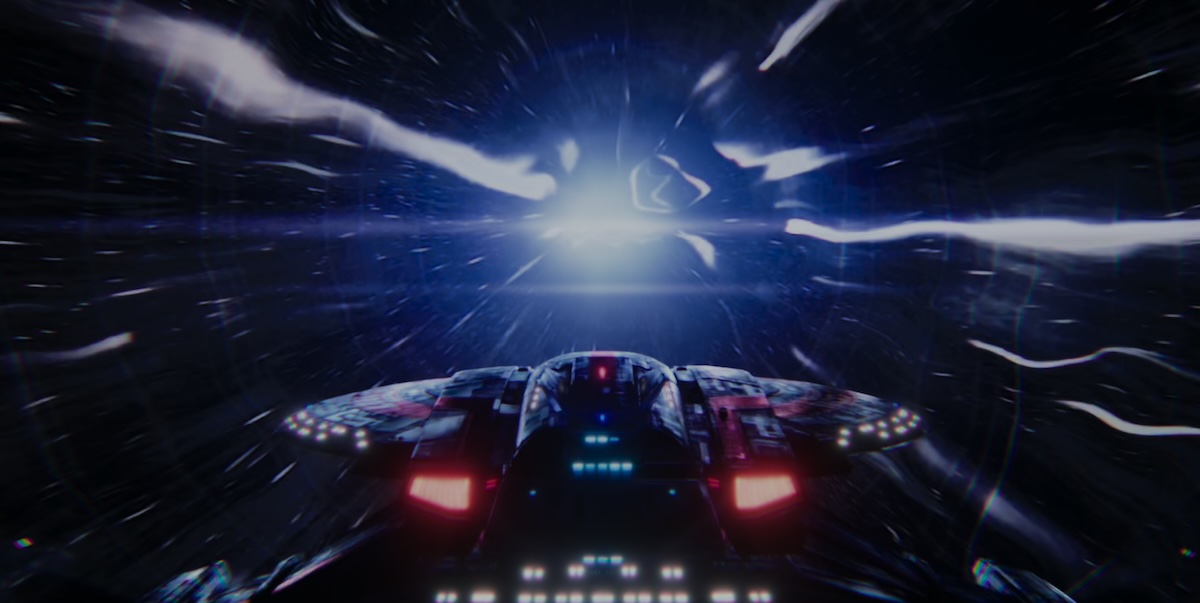
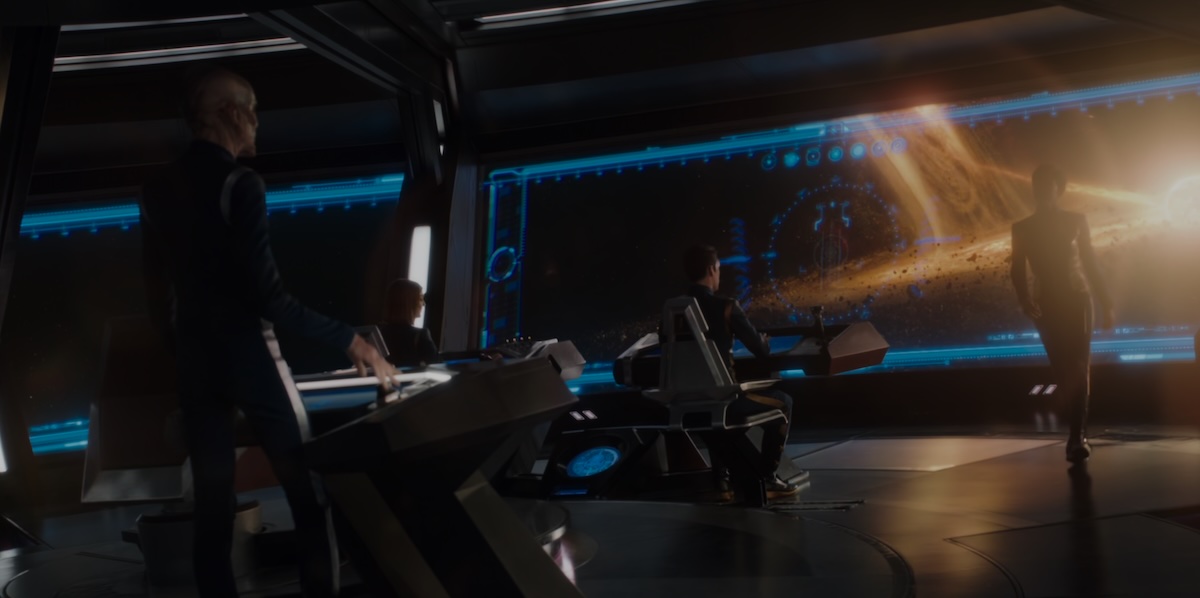
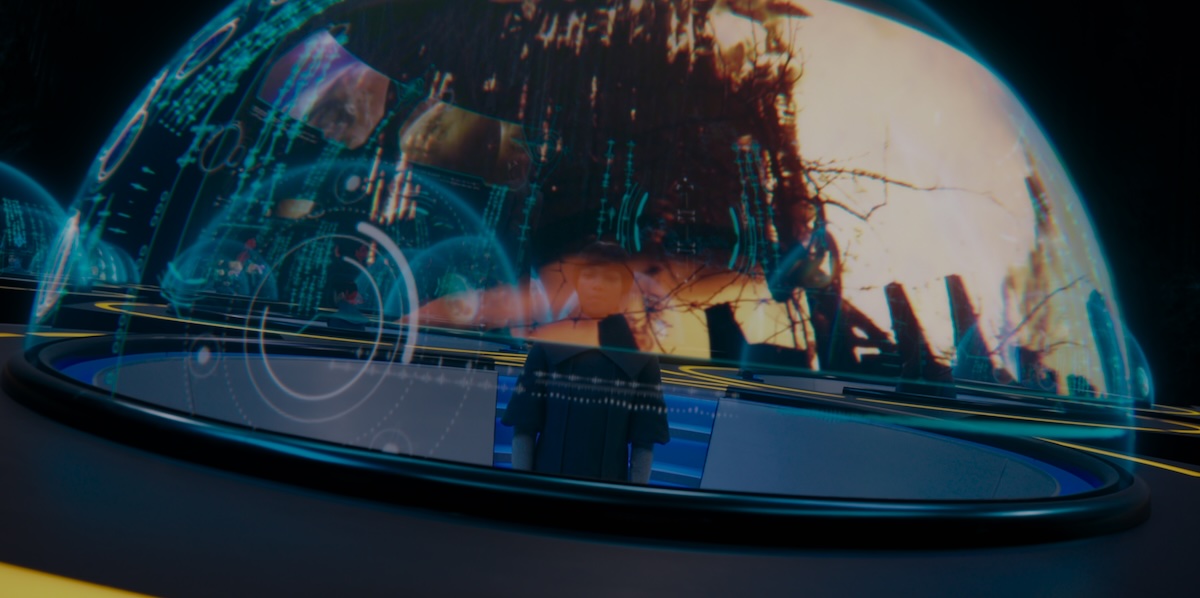
Warp speed is warping, as though the ship is tearing through the fabric of space like a zipper off its line. (You should see the warp speed in Academy.) A darkened, industrial starship bridge prioritizes huge viewscreens and the maelstrom beyond, because space is scary and we need lens flares. A traumatized child is presented cocooned in a bubble of her own grief, courtesy of an overwhelming heads-up display. One would be forgiven for thinking that in the future presented in NuTrek, it’s daily terrifying to be alive.
Disco was not an easy birth. Showrunner Bryan Fuller — who had written for Voyager back in the day, and created the beautiful, unapologetically maximalist Hannibal series in the meantime — left Discovery before it aired. In glimpses, we might see something of where Fuller was aiming his project…
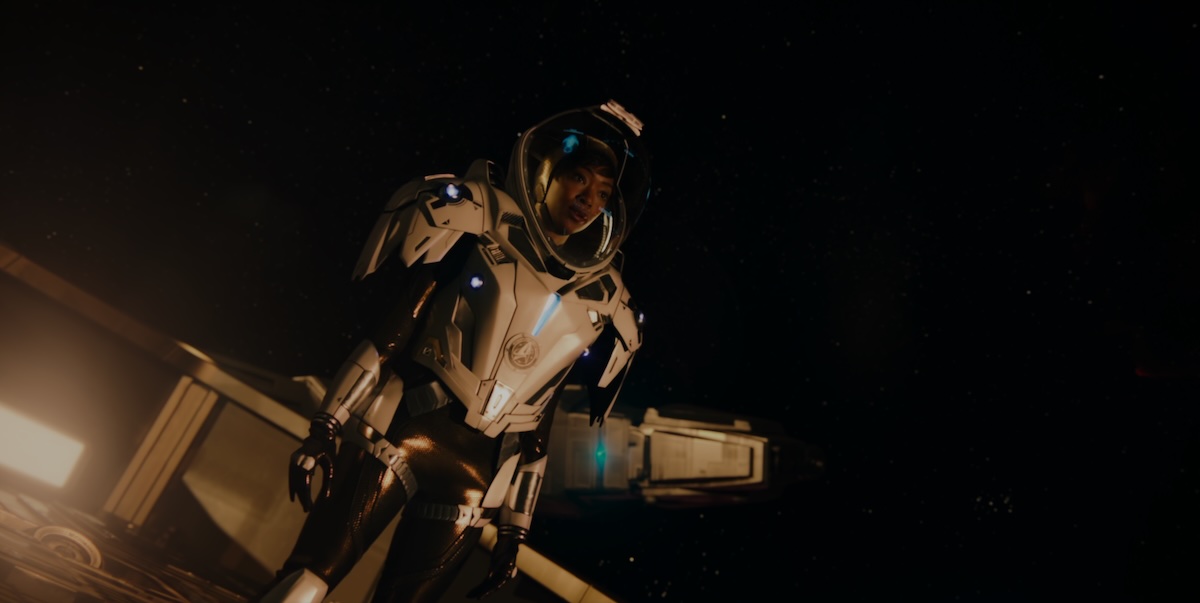
…in which space is dark, and unknown and therefore scary; look at the high key on Michael Burnham (Fuller’s premise, notably, centred not only a woman of colour but, for the first time in Star Trek, someone who was not the captain and therefore not the final stop of responsibility) and the inky blackness beyond.
***I’d also be remiss if I didn’t note that the only NuTrek series that don’t hew to this visual language are the two animated entries, Lower Decks and Prodigy. Both of them are susceptible to some of modern Trek’s anxiety with Star Trek as a format, but not visually. Both series continuously imagine a visual future that is more in line with the principles of — at least — the Rick Berman era, if not the original Roddenberry. Both series are also, notably, omitted from the 60th anniversary Star Trek ident that plays before the episodes of Starfleet Academy, which scans through all of the live-action starships (the original Enterprise appears three times) but skips the Cerritos and the Protostar. This suggests that the NuTrek producers don’t consider Lower Decks and Prodigy “real” shows. That’s a strategy that works both ways, imho.
The NuTrek aesthetics are all, in turn, inherited from J.J. Abrams’ faithless reboot of the franchise in 2009, in which the director delivered a zippy space adventure movie (it’s quite good!) that nonetheless seemed like it couldn’t be less troubled with resurrecting Star Trek as a premise so much as Kirk and Spock as recognizable icons for the brand.
Plus, it was all just a showreel for Abrams to get Star Wars, which he did, and which is why you get shots like these:

That’s the first shot in the movie, and to screencap it as a stillframe doesn’t really do it justice; this shot is nuts. The U.S.S. Kelvin whips past the camera at so fine a distance it might well have chipped its own paint, before cartwheeling out to reveal itself in full splendour against an outer space scary-thing that will, shortly, kill Captain Kirk’s father. The “camera” that the Kelvin only barely doesn’t hit is covered by CGI “dust” that doesn’t actually exist — you can see some of it against the darker parts of the frame, above — but provides, you guessed it, plenty of grist for lens flares.
Again, Star Trek 09 doesn’t really care about Star Trek as a format, and is broadly more interested in lending a “they’re just like us!” relatability to the proceedings, lest any audience member who wandered into the theatre think they were watching a movie about the future.
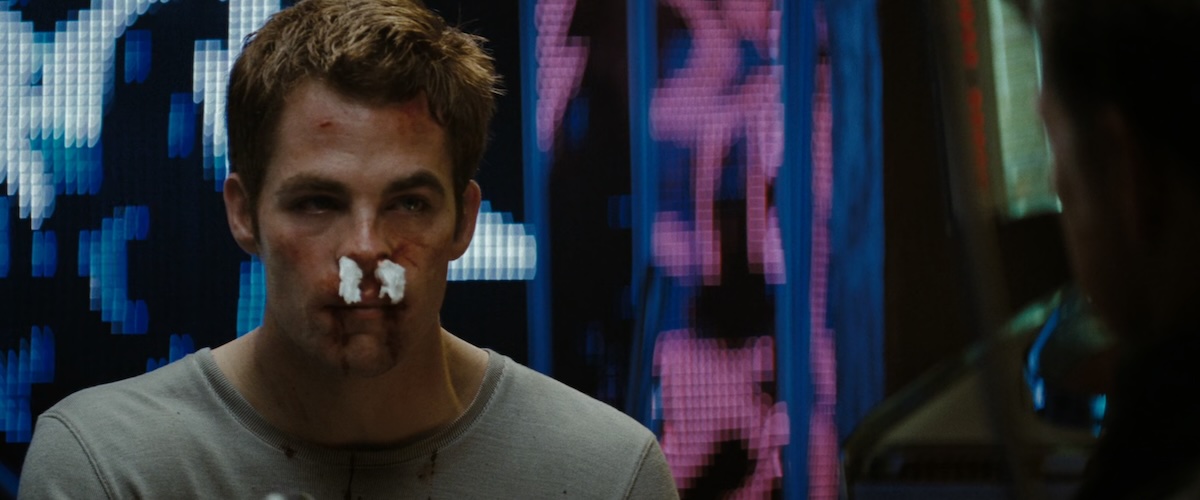
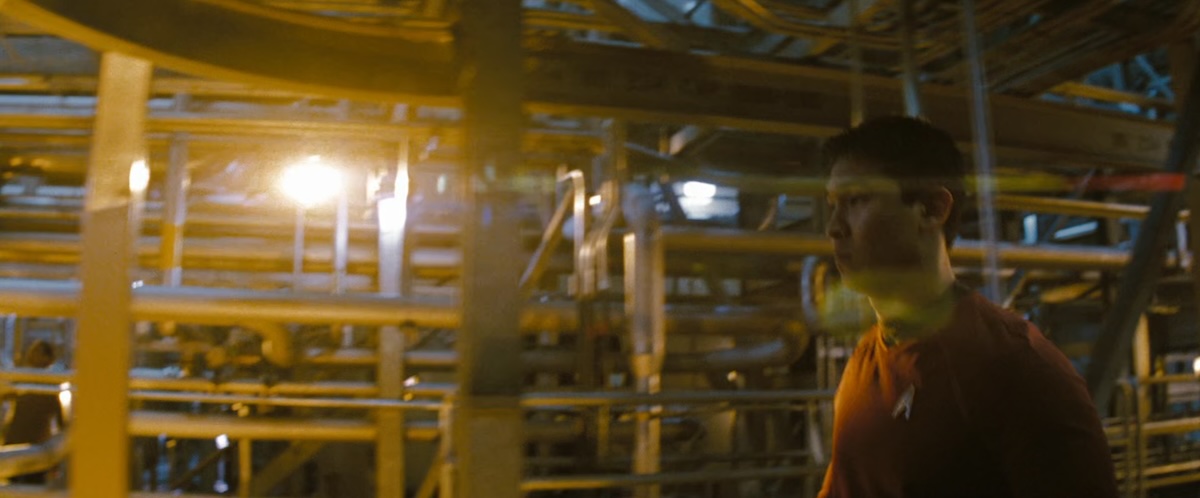
Abrams innovated shooting portions of the Enterprise in working 21st-century industrial locations, such as the Budweiser brewery above that stood in for Main Engineering.
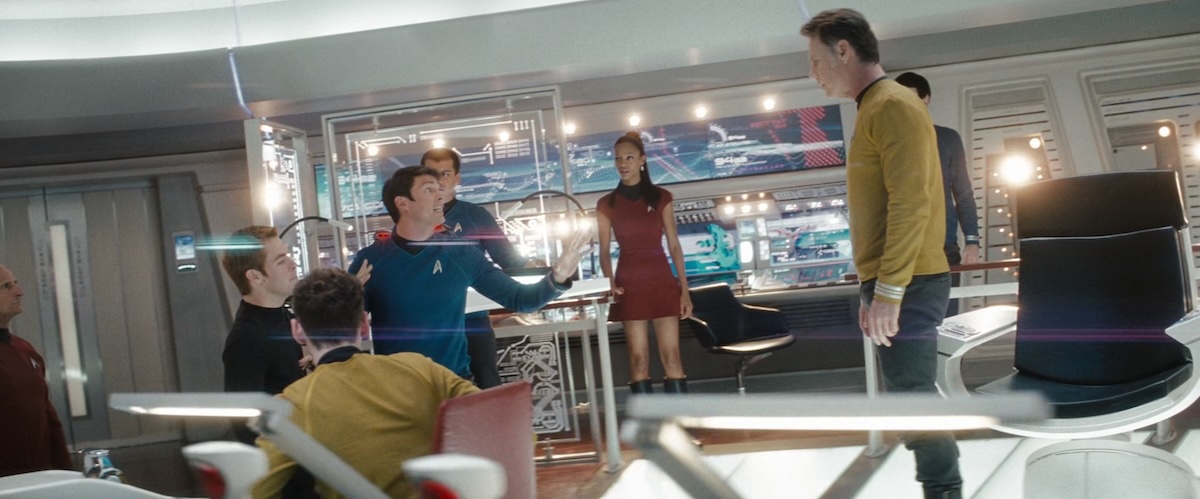
And, again unfairly stillframed here, Abrams’ camera moves. It’s fair to say that in Abrams’ two Star Trek movies, everything’s in a state of high panic all the time, and the camera goes along with it, slinging and whirling around clusters of people who populate an Enterprise bridge that is so desperate for lens flares that it has two or three dozen halogen kickers built into the set, pointing outward.
The movie is pure visual noise, and to a large degree that’s Abrams’ point; his Enterprise is not a starship in the future, but any high-pressure workplace (many have mentioned the Apple Store, lol) in which a teenager or twentysomething might work today. That aesthetic principle lines up directly with the “Bama rush but it’s career day” vibe of Starfleet Academy‘s main set.
Compare:
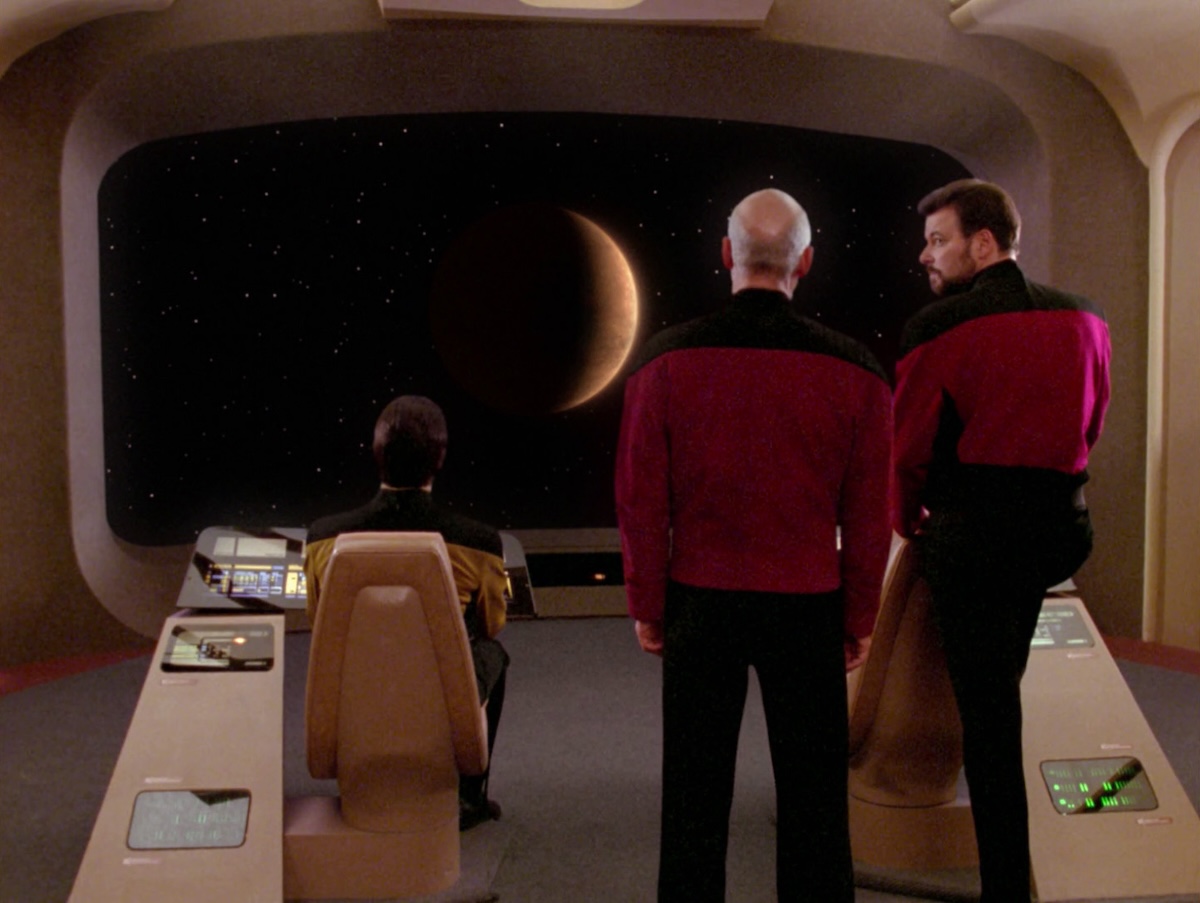
Star Trek: The Next Generation got a lot of shit (continues to get a lot of shit) for its Hyatt-Regency interior design. Consider for a moment, however, that the visual design carried meaning. What kind of a future is designed like this?:
- One where form is wedded perfectly to function
- One where machine utility extends only as high as the humans need it, and no further
- One where the most interesting things to see are outside the ship, and the interiors are therefore not designed to distract from them
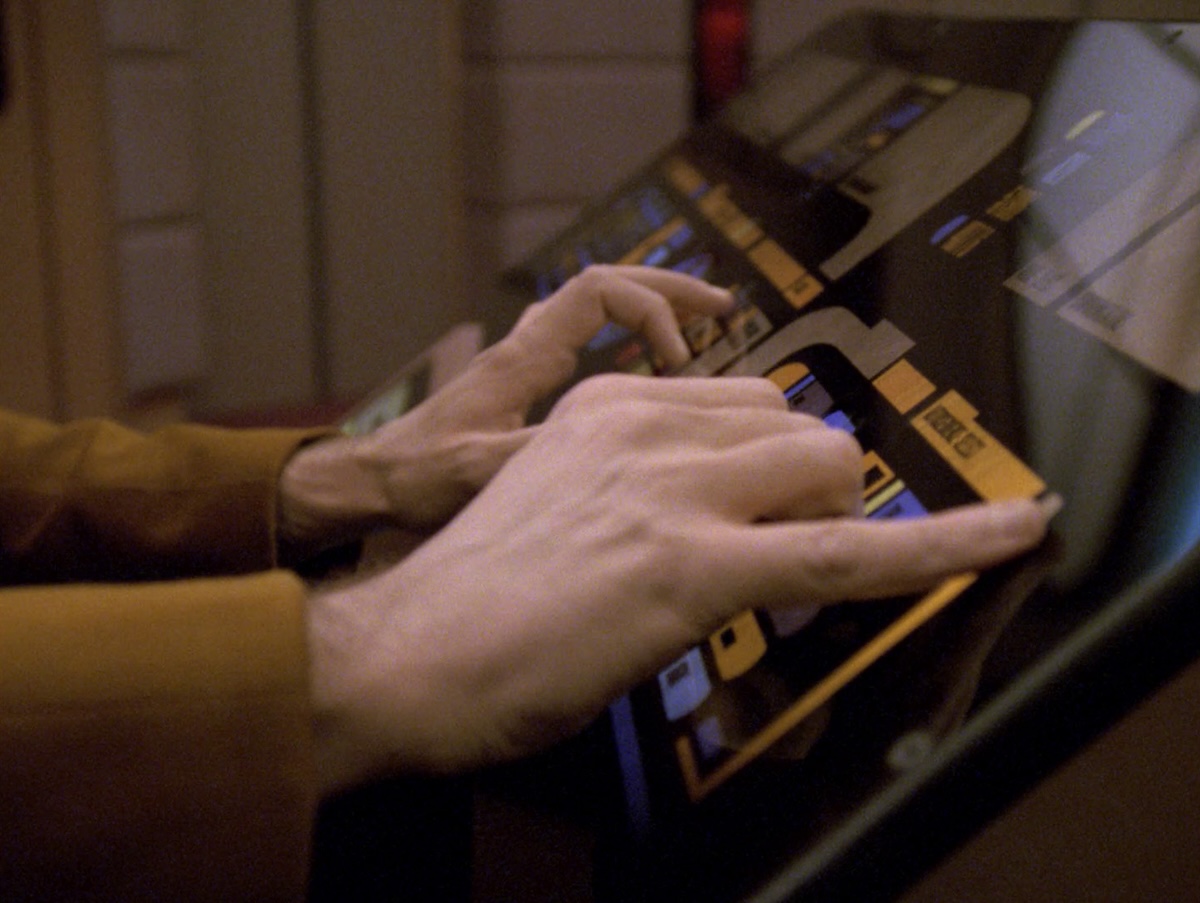
The LCARS display is not a whirling maelstrom of flashing and beeping; it’s a simple multi-purpose interface (it is, in fact, an impossible interface by today’s standards, which means it still suggests a level of design improvement we might aspire to) that allows device control with a simple sequence of elegant finger-strokes.
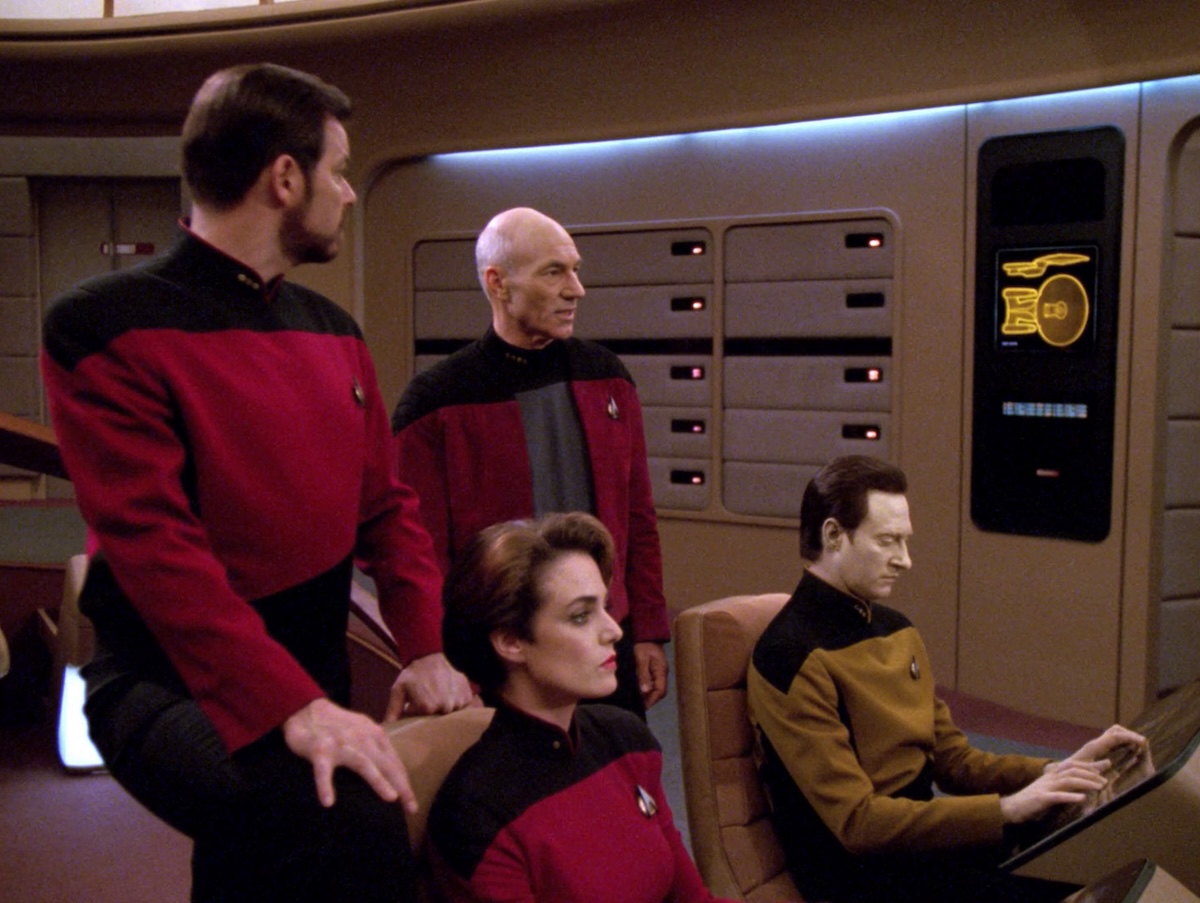
Next Gen’s set design and aesthetic principles are worth considering because, again, they were the last overseen directly by Roddenberry. Everyone after him — including Rick Berman, later in the era — visualized a future made up primarily of gunmetal interiors and cutting-edge (for the year of its production) visual displays. The warmth of Next Gen’s production design has been missing for multiple decades; oddly, it only gets hinted at nowadays in the fact that not one, not two, but three NuTrek captains have have roaring fireplaces in their offices.
There is one area where Starfleet Academy gets the argument between its own text and subtext right, with which I’ll close: again, the (young) cast. Leaving aside the adults — who are their own pack of weirdos, and each of whom evince a different premise of future human behaviour, with which I have some problems — the beings that the Starfleet Academy creators chose to include amongst their students each hold the whiff of that old Star Trek idea of infinite diversity in infinite combinations, giving the true ideal of a future society.
Faces, eyes, bodies, the kinds of images we are given on Starfleet Academy, are not just about the backgrounds or the “world.” The latter is visually and kinetically hostile; the former — the foreground — is squishy and warm in the way that Star Trek needs to be.
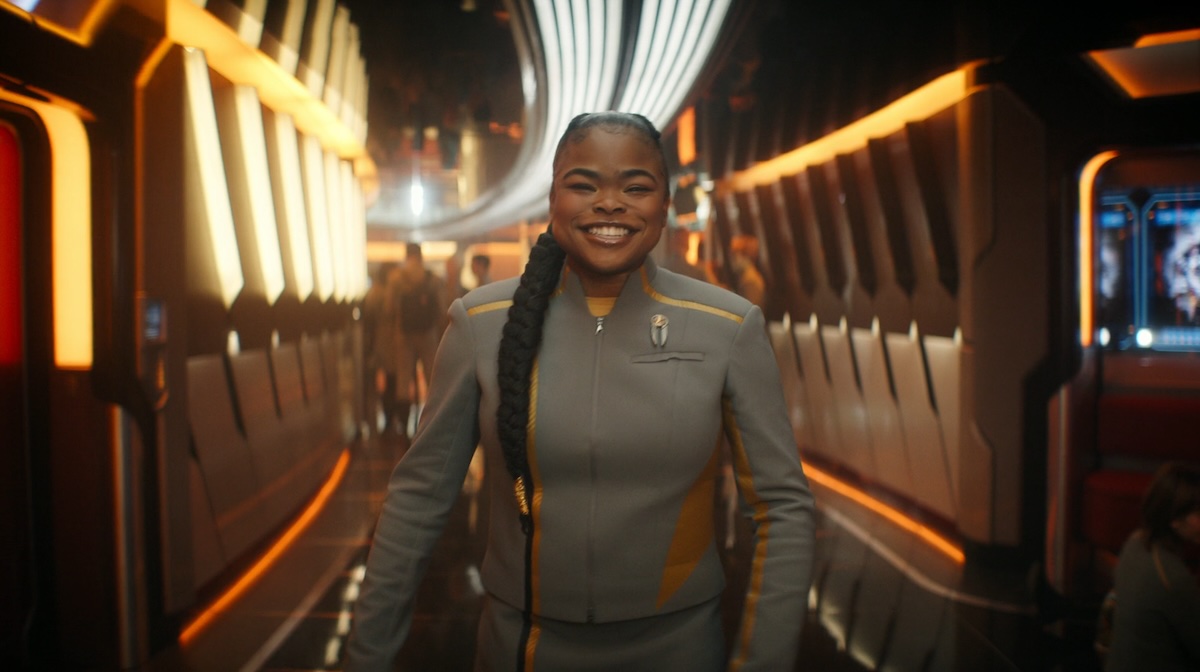
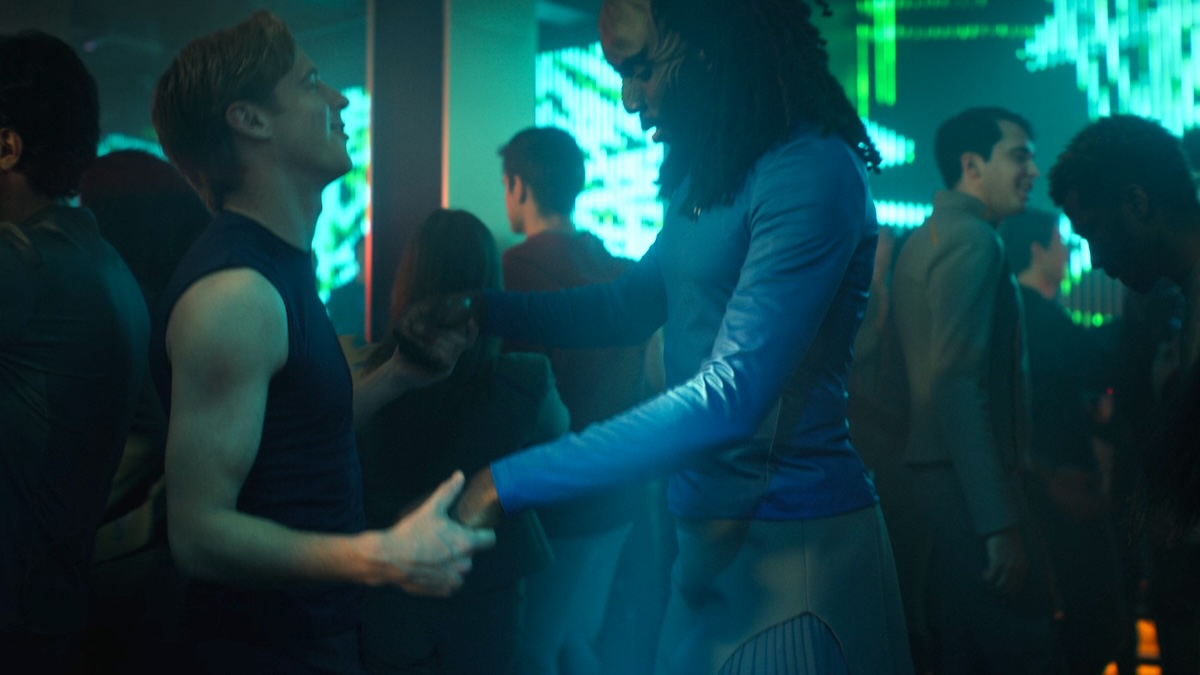
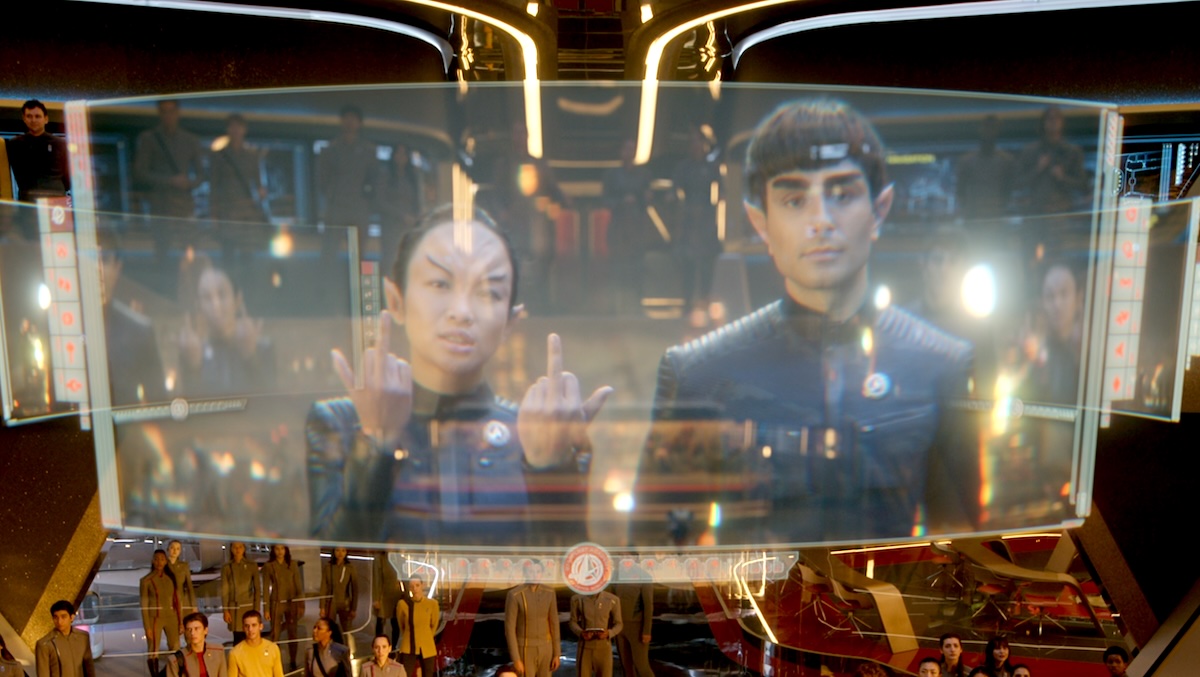
Whether it’s SAM (a holographic being only a few months old; the character best-positioned to comment on the human condition in the tradition of Spock or Data and, like those characters, clearly spectrum-coded) or Jay-Den (a towering Klingon who eschews both standard Klingon blood-lust and standard masculine attire, bringing back the Next Generation-era non-binary menswear for the first time in live action), or even Dzolo (a Romulan Mean Girl paired up with an equally snooty Vulcan Mean Boy, i.e. the two characters that absolutely have to exist in a school-set YA story for such a story to work), the student characters, by and large, seem like they could cohere into one of the great Star Trek casts, given a bit of runway.
Starfleet Academy has already been renewed for a second season. Whether it goes further than that becomes a direct question to our own consumerist, capitalist hellscape, which the series seems so desperate to position itself within: with new, Trump-supporting leadership at Paramount and a broad, anti-“woke” political movement having overtaken the fascist United States, Star Trek finally finds itself in the crosshairs of its own production era in a way it has not been since the 1960s.
I return to that question of how one imagines the future. In 1966, the original Star Trek pushed boundaries by imagining an American future of globalism, in which racial and nationalistic lines had inevitably (?) given way. Even capitalism, it should be noted, had given away by Star Trek‘s 23rd century; but the series was, and remains, a plank in Cold War-era moralizing about, ultimately, which system was better: “ours,” or the Soviets’.
A recent episode of Jon Stewart’s show, though, put me in mind of the fact that the current Cold War, if there is one, could be boiled down to a duel between progressive and regressive political climates worldwide. In this framing, our entire national enterprise (sorry) must support the grand thesis of which way of living, thinking, and being is better: progressivism or supremacy.
For the United States and all other fascist oligarchies, Star Trek as a format now suddenly finds itself on the wrong side, given that its future inherently assumes that brown people, queer people, and diverse people of all kinds are fundamental to our survival as a species; effectively, that a polyglot is a better, more admirable being than a supremacist.
Where does Paramount — firmly in bed with the Trumps — pivot Star Trek, going forward? Does Starfleet Academy continue? Will the developing Star Trek feature film hold on to those ideas of diversity and pluralism, or (like Abrams’) yearn for a nostalgic past in which complexity can be sanded away in favour of run-and-jump adventure? How do you imagine the future?
Enjoying this newsletter?
It’s still (mostly) free. But if you enjoyed this piece and want to see more like it, consider a one-time donation.
Further reading and watching and doing of things
Well. Now you know why I split this piece in two. Jeeeezus. Anyhoo, here’s some stuff by other people, none of which is about Star Trek:
- This is all great but whiffs strongly of “Kenner Early Bird Certificate” (iykyk). Hope the kids enjoy those toys, but more so I hope that once Netflix realized how badly they’d bungled this, they had a significant internal review on how they can have so many creative executives and yet not one of them noticed that they had a phenomenon-in-the-making in the house, until three weeks after it premiered. (Deadline)
- Hey speaking of Star Wars figures, I finally got a new Star Wars figure. It’s good! (Giant Green Space Hand)
- I’m always pretty happy to listen to The Watch but I gotta say, their coverage of Industry this season has been over-and-above — both in terms of addressing the skill level at which the series is currently playing; but also the wider (sorry) industry conversation that television like this innately represents. Worth a listen (The Ringer)
- Did you know Faith Erin Hicks has a newsletter? Now you do! (Pencilbooth)
Also: little consolation in times like these, but if you want the latest example of why progressive, free-thinking people are just fundamentally more unique and inspiring than the Nazis overtaking the world, consider these two modes of protest:
- The Dildo Distribution Delegation (Closer to the Edge)
- This 21-Year-Old Bagpiper Plays Through Tear Gas (L.A. TACO)
Our team, all the time, every time. Fuck ICE and fuck the acquiescent.