
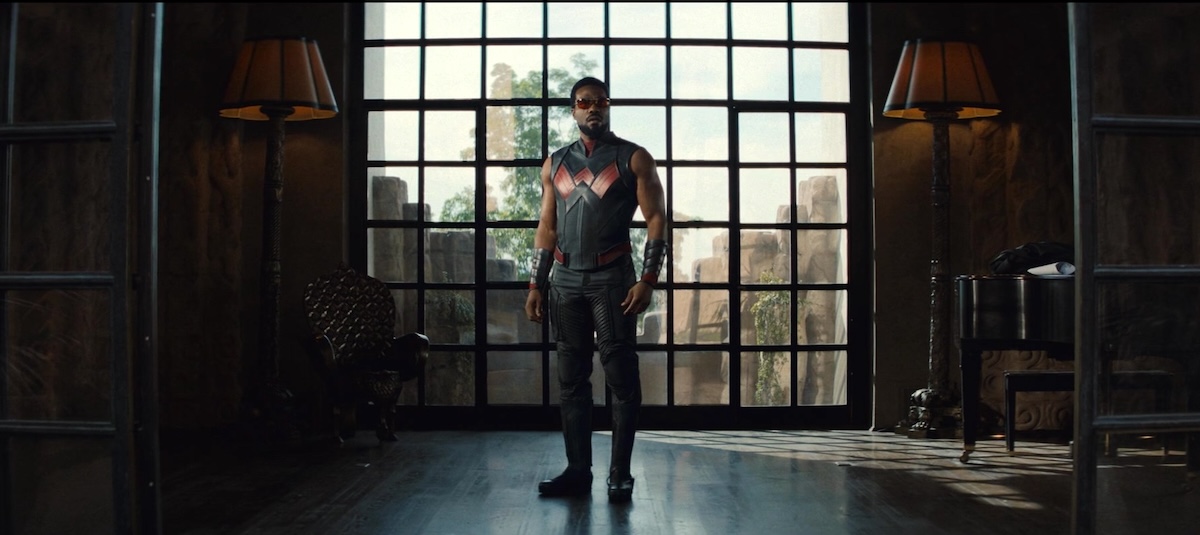
One of the reasons I’ll remain one of Marvel Phase Four’s handful of defenders is that I’m just a wild-swings sort of a person, and that was their wild-swings season. It was as though the success of Endgame emboldened them to learn all the wrong lessons from Guardians of the Galaxy and just go nuts with it. To be fair, they — like the rest of us — were probably operating under the false assumption that the majority of the American public was into the progression of Marvel because they were into cooler, weirder stories, and not just white guys named Chris. In the pivot point for what turned out to be the rupture of the American empire, it all seemed so possible.
Anyhoo. Marvel’s still going, the white guys named Chris are back, and at this point, even I am not really going with it.
That’s a big change! Even when gen pop jumped off the bus three years ago, my over/under on the MCU was still pretty high. I accomplished this by generally taking Marvel less seriously than most people and somehow also more seriously than other people, and for a while the balance was perfect.
But I have to admit that the advent of Phase VI — can you believe we’re in phase bloody six now, or that phases even still have names — really took the wind out of me. The pivot away from more specific, more diverse stories and back to the mean, interests me not a jot. Action movies that are “fine” bore me more than nearly any movie that is “bad.” I prefer the Whedon Avengers movies to the Russo Avengers movies. Sorry.
Into this becalmed death spiral sails Wonder Man, who seems like a breath from another era because whoops, he is. Somehow, this latest — last? — of the one-shot flavoured, “we swear you don’t need to watch anything else to enjoy this!” Marvel TV projects for Disney+ — of which there were so many in phases 4 and 5 that even this writer has lost count* — has been in production since before the strikes. They shot half the bloody episodes before the strikes! The strikes were in 2023!!
* Ok fine, I’ll count ’em. And rank ’em, cuz we’re here.
- Loki
- Moon Knight
- She-Hulk: Attorney at Law
- Agatha All Along
- What If?
- Ms. Marvel
- WandaVision
- Eyes of Wakanda
- Hawkeye
- Wonder Man
- Marvel Zombies
- Ironheart
- Echo
- X-Men ’97 (which reminds me: I haven’t watched whatever that Spider-Man show was)
- The Falcon and the Winter Soldier
- Daredevil: Born Again
- Secret Invasion
Phew.
I don’t know if I think Wonder Man is good, mind you. (I also, definitely, do not think it is bad. As you can see above: it’s kind of in the middle.) One thing Wonder Man definitely is not, though, is fine. It is a 100% pure shot of “its own thing,” complete with the YMMV sticker, and my mileage did. I’m more impressed with it than I am in love with it. It’s actually loony to me that this got made at all, let alone that it was never Zaslaved into nonexistence by a studio desperate to regain some of its fallen cultural capital.
Wonder Man is a show about a guy trying to make it big as an actor, but he’s a bit of a whacko (the showrunner references the Jeremy Strong New Yorker article, yes that Jeremy Strong New Yorker article, as a north star for conceiving the character). He picks up a side man in the form of the guy who pretended to be the Mandarin back in that movie where the Mandarin turned out not to be the Mandarin (from whence my very first Screen Anarchy column hailed, hurrah!). Together, they bum around Hollywood and try to get something moving. Oh also, the main guy has superpowers and the other guy used to be the Mandarin, both of which prove awkward for their careers. Wonder Man is The Studio or The Franchise but with less, and softer, jokes. It’s the least-Marvel Marvel series ever produced, by a considerable way.
And I don’t mean in the obvious ways you’d think of when I describe something as being not very Marvel-y, i.e. the constant self-referentiality, the larger MCUniverse of it all. (There’s none of that, either.) This one, for all intents and purposes, takes place in the Marvel universe only theoretically, and involves superpowers barely at all. (The super-suit in the headline image for this post is a costume for a Wonder Man movie, not the kicking-ass uniform for an actual superhero named Wonder Man.) It’s just a show about regular shmoes being regular shmoes (and being bros… they are shmo-bros) and it’s kind of wonderful that it even gets to exist. Its closest antecedent from the studio is another YMMV project, albeit one where mine varied much higher: She-Hulk: Attorney at Law, a largely-reviled, all-but-forgotten, entirely bonkers project that was — till now — as firm an example of Marvel standing out their marker and saying “we can do all kinds of different types of entertainment in here” as (it turns out) we were ever going to get. She-Hulk was top-twelve Marvel, for me, which is not an easy club to get into, with or without Doorman Davis.
(I’m agnostic on the subject of whether the cameos and crossovers make Marvel projects better or worse, but I will say: a Jen Walters episode of Wonder Man would have made a lot of sense.)
Give or take a Thunderbolts*, last year was pretty grim. The efforts to navigate Marvel back to centre have been clumsy at best, and much worse (to me), incredibly dull. The reboot of Daredevil was a disaster; the reboot of the whole cinematic universe (in Fantastic Four) was forgettable. Even the better stories of the last half-decade are now being actively counter-texted: it’s hard to imagine a worse fate for the earnest (though muddled) interrogations of supremacy in The Falcon and the Winter Soldier than becoming the ugly, both-sides speechwriting of Captain America: Brave New World. Or the human charisma-bombs of Iman Vellani and Hailee Steinfeld being gulagged, after Hawkeeye and Ms. Marvel and The Marvels, into a couple of animated projects and otherwise, nowheresville, just because both characters happen to have vaginas.
Most of all, it’s hard to imagine any narrative intrigue in what we’re sailing towards right now: Avengers Doomsday (at least the title is apt), which is somehow both a giant reset button for a franchise past its stale date, and a legacy sequel for not one, but two incarnations of Kevin Feige’s career overseeing Marvel movies. Especially when the latter already got its own legacy sequel two years ago, and it wasn’t that great.
The greatest television season of all time
sub-hed: for de yoots: “what’s a season?”
I don’t know, man, I just know that January and February were kind of wall-to-wall brilliant from a television perspective. I wouldn’t even post Wonder Man up there — in a weaker part of the year, it might have stood out — but we’ve had Industry, A Knight of the Seven Kingdoms, The Pitt and Starfleet Academy all at once, and for a very brief nexus of time, television felt like something fun and normal and good.
(That all of the shows I’ve mentioned, save Wonder Man, are weekly drops instead of what I’m beginning to see increasingly as The Engagement Killer binge-drop, helped. Two whole months, where there was stuff to look forward to all week? What is this, 1998?)
All of these have concluded as of this writing except The Pitt, which is now in the second half of its season (15-episode seasons, what a concept!) and firmly demonstrating the architecture of its project. The Pitt and Knight are in production on their next seasons already, which argues for a return in early 2027; and Industry is marshalling forces for a final, fifth season. Its fourth turned out to be its best: or at least, further evidence that Mickey Down and Konrad Kay are deeply invested, and rigorously adventurous, with what they’re interested in tackling on their show that is definitely no longer (only) about finance babies being assholes. It’s inspiring television.
As for Starfleet Academy, well, y’know, hit and miss. The biggest miss dawned on me late in the season, and after word that they’ve wrapped the next season already with no confirmation of continuing: this, for a teen drama, is all too short. Kaleb Mir arrives at the Academy in week one of the eponymous show and eight weeks later, the season, the school year, and the first year of the show are all done.
I don’t mention this to jump aboard the formulaic “TV seasons are too short nowadays!” bandwagon (but see above re: 15 episodes), but rather because in a format built around an IRL year — which high school shows generally are — the flow of time matters. (Maybe once I’m done my ER rewatch I’ll babble out a few thousand words about how that show, the anti-Pitt, uses the annual flow of time.) The way that the audience experiences time alongside the students is important, because it provides ballast to the all-or-nothing, oh-my-god-everything’s-so-important!!!! angst that is (in real life) hormone-driven for teens, and (in their TV adventures) supported by our empathy for them. The 9th episode of Starfleet Academy is called “300th Night,” and it’s kind of stunning that we’ve only seen six of the prior 299, yet are expected to feel like the kids have gotten somewhere.
In short: we need to spend time with these adolescent whackos, not just story, or the milestones don’t feel like milestones at all.
The compression on Academy exacerbates a problem all the modern Star Trek series have had, which is their tendency to tell us a relationship is important because the story needs it to be, rather than building the connection organically and then exploiting it. I’m impressed that Academy has gone to the trouble of creating a web of overlapping relationships among its core six characters which are genuinely thorny and interesting, and frustrated that the series has taken exactly zero time to play any of those dramatic stakes out, preferring instead to rush along to the next thing. (Recent example: Sam gets rebooted at the end of episode 8; in episode 9 she’s being a dick to her roommate who is sad about it. How Sam feels about having been rebooted is left between the episodes. See also: the Doctor’s major emotional change this season; see also: Jay-Den’s entire journey, apparently, from awkward loner to kid doing a blood ritual with his found family in his quarters.)
As written in previous instalments, and given the recent WarnerMount collision, it’s likely, and looking likelier, that there will be no further seasons of Starfleet Academy after they deliver 2, whenever that will be. Alex Kurtzman — who has overseen the entirety of NuTrek — has his contract expire at the end of 2026. With a new Trek movie in the works at Paramount, I wouldn’t be surprised to see us start over with the ludicrous and frankly unsupportable belief that Star Trek is a big-screen franchise first and foremost. (Don’t let the fact that Star Trek II exists distract you from the fact that Star Trek movies have always been, on balance, an impossible proposition.)
But also, given David Ellison has no track record at all running a studio (let alone two), it’s also worth saying that we have no idea what’s going to happen next, if anything happens at all. I’m not holding my breath on seeing Genesis and the kids graduate, is all.
A few more things to look at
Look, I just like curating links. What can I tell you.
- “[Dubai] is hellish because, as the self-appointed showtown of free trade, it provides normal people with the chance to buy the purest form of the most heinous commodity: the exploitation of others.” Caitlín Doherty regrets ever going there. (Sidecar)
- I’ve taken to calling my phone “you little asshole,” so much so that I wish I could reprogram Siri to respond to it. (“Hey you little asshole, add mushrooms to my shopping list!”) Anyway, Malcolm’s latest banger came at the right time, is what I’m saying (Strategy for Life)
- Real good video on what happened to The New York Times. (Lily Alexandre on YouTube)
- I groaned with pleasure reading this. (Anxiety Shark)
- People are all the time asking me, is One Battle After Another going to win Best Picture, or is Sinners? The answer: is yes! Here’s a great essay about one of them. (Liberties)
- Do you, like me, look at Playboy for the articles? Well, here’s a good one: on the icky vergence of trans rights diminishing, while trans porn is booming. (Playboy! Who knew!)