
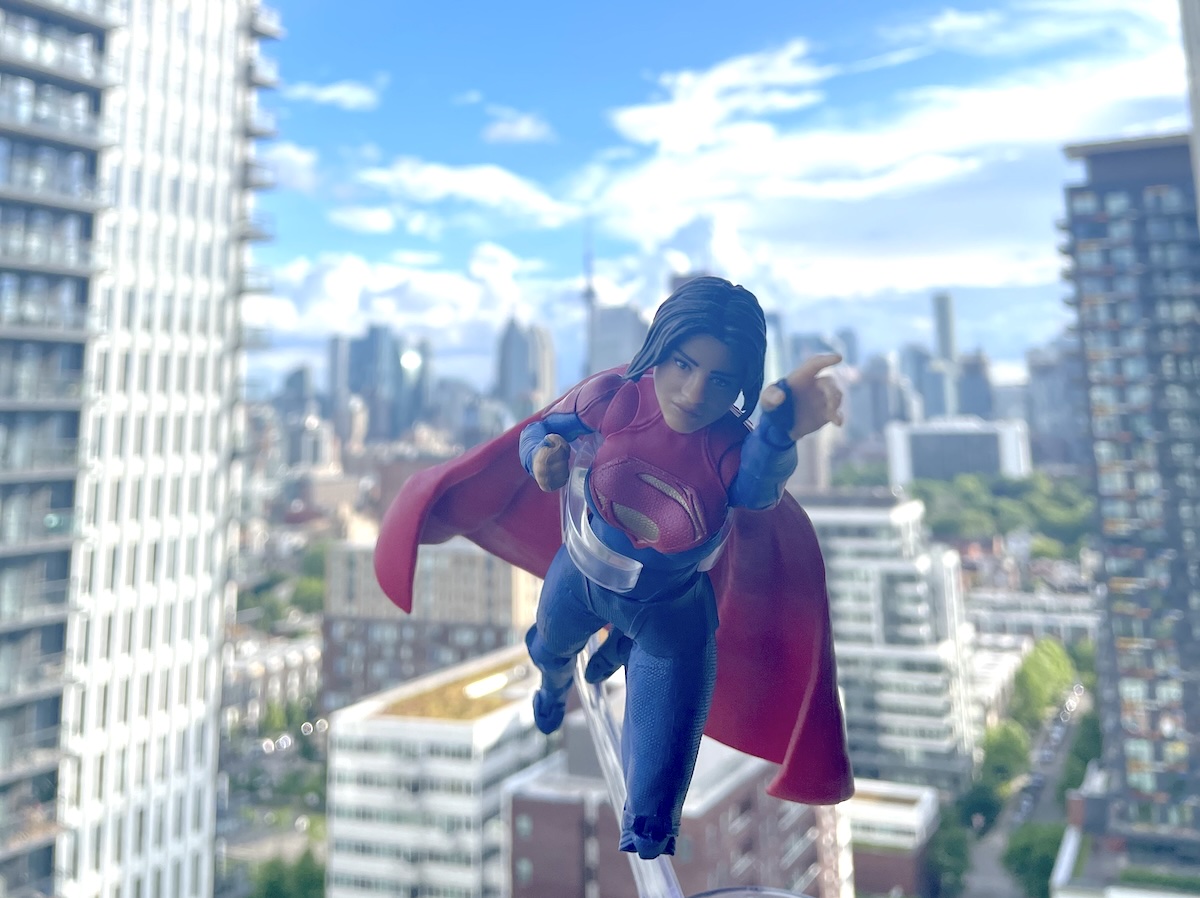
I cracked open Tom King and Bilquis Evely’s Supergirl: Woman of Tomorrow for the third (fourth?) time a couple weeks ago. I’m sure little more than the spine of the concept will make up this summer’s Supergirl feature film (whose longer trailer also dropped last week) but one wishes for all of it. It’s such a thorough, inventive work; but it is a comic, after all, by which I mean, each of its 8 issues is its own story, not a machined block of a larger narrative that is only interrupted by the end of each 22nd page. Diversions to, say, the green-sun planet, or Supergirl’s race with Comet to the edge of reality, probably won’t make the film.
Plus, they had to fit Lobo in there. I understand the assignment when I go in for these things.
Now, as the kid who played Supergirl on the lawn with her best equally-if-not-more-so-queer bestie wayyyyyyy back in the ’80s (and as an adult who has an Italian Supergirl ’84 poster dominating so much of the kitchen wall that one almost can’t plug in the toaster), I can say with my whole chest that I both unabashedly love Kara and always have, and also allow that in terms of definitive Supergirl stories, there have basically been zilch, up till Woman of Tomorrow.
I mean, throw out anything pre-Crisis, when she was the girl-variant-Superman that was de rigueur for all superheroes back then, with all the attendant problems of same. I don’t mind New 52 Supergirl as a protean form of what we have now, with her teen angst so deep she actually became a Red Lantern, but the juice of that story never seemed to land, the excavations of Kara’s whole premise getting in the way of telling any actual stories about her. One of the reasons I give Sasha Calle’s performance as Supergirl in The Flash more room in my brain than it properly deserves is that she gets at a bit of the sadness, and the bravery in spite of that sadness, that (to me) has always felt like it lived somewhere within the character, a harmonic that Clark never quite reached.
Part of the reason Woman of Tomorrow feels like such a linchpin statement on the character is that it grounds Kara not just in her own trauma — King borrows from Jeph Loeb’s retcon/resurrection of Supergirl in The Supergirl from Krypton, i.e. in that while Clark escaped Krypton as a baby and grew up on Earth, Kara, due to temporal shenanigans, was a teenager when her planet exploded, and was still one when she arrived on Earth — but it goes further, to articulate why Kara’s response to that trauma is the nucleus of both her power and her spirit. It manages the trick of letting the now-adult Kara hold two ideas simultaneously: that the ruin of her world is a grief too large to be borne by anyone; and that her innate kindness is in fact both unrelated to, and entirely intrinsic to, her bearing it all the same.
Here’s a line that stuck out to me this time: “The months of witnessing the cruelty of all things had worn her down to her true self, to the girl in the rocket, fleeing into the sky.” (Non-spoiler, I guess: bad things happen to hero character en route to the third act.)
It had me thinking about origin stories, which might be another way (in comic-book language, anyway) of articulating that we all have a primal scene, that moment, an intrinsic self that is never fully shed or changed — and which can be exposed, years or decades later, through trial or hardship or lots of thorny, complicated work. Origin stories always must mean, the reason for the hurt is the reason for the strength. For Kara in Woman of Tomorrow, I think it’s more like: her “origin story” isn’t the origin of who she is at all. It was only the first test of it.
And maybe the reward for all the testing and the questing is exposing that person, that moment, a second time, and seeing how she holds up.
Look, last week was a bad week. Part of it was that selfsame brutality, “the months of witnessing the cruelty of all things.” We’re all staring into the cold-white engine of that, and it’s a pick-’ems as regards what scares me the most about it: that we’ve become so sanded-down by horror that we’re scarcely feeling it anymore; or that there are people who are perfectly capable of tuning it out completely and living heartily uninvolved lives, and I’m just not one of them.
But I’ll tell ya, in and around all the perfectly normal things for me to be angsting about and underneath the more apocalyptic ones, I’ve bounced off the recapitulation of my own origin story enough times since the turn of the year that I’m starting to sense the rhythm in it, and with that rhythm comes a refreshing sense of heart. Less so “this isn’t so bad,” and more so, “this is resistance,” and it turns out my heart’s doing just fine. It’s human, and it’s strong, and getting stronger.
There are Narnias in your wardrobes
Something my friend Malcolm likes to do is send me longreads about A.I., most of which (up till now) have been of the general “A.I. Bad” sort, but (more recently) have occasionally included “A.I. Not That Big Of A Deal” varietals.
I’m kind of easing into the latter camp overall, albeit with the gargantuan asterisk around stealing people’s work, and the even larger one of the enormous environmental impact to our already-imperiled planet that A.I. data centres create and will continue to exacerbate.
Those apocalyptic threats notwithstanding, however, this whole mess might finally be sliding into the “not that big of a deal” phase of its life cycle. I mean, everyone can see that this shit is ridiculous, and basically achieves nothing valid or valuable, at least in terms of the “bUt WhAt IF A.i. rEplaCEs hUman arT???” question that seems to be foreground for most anxiety on the subject.
More to the point — and I think it is the point of much of this piece by Adam Mastroianni as well, which is what prompted my thoughts here — I came out of last week strengthened on the idea that the human spirit is, quite simply, stronger, better, richer, more insightful, tens of dimensions deeper, and infinitely more worthwhile than anything the supercomputers are ever gonna spit out.
That entirely-non-unique insight isn’t going to solve the climate crisis (at least not directly) or make It happen (but I bet we’re going to create some incredible shit once It does), but I nonetheless feel realigned in my sense of my/our place in all this. Which was, for the second time in a week, heartening.
(Plus, overall, it’s hard not to feel heartened when you’ve watched a lunar launch live for the first time in your nearly-fifty-years-on-Earth. I mean, what a fuckin’ planet, amirite? What a race of beings we are, aren’t we???)
Listen, I don’t go in for Jesus, or any of the other god-whackos. But I’d be a fool not to notice the winds of synchronicity when they are blowing. (Last week on the A More Civilized Age podcast, Austin Walker put forth the rather brain-smashing idea that “the Force” is actually “the force of narrative momentum and agency,” i.e. that when we say “the Force is with him,” we basically mean “the story’s on his side now.”)
Here’s something: a bunch of Deadwood stuff fell into my life all at once last week, first with Emily St. James’ deeply absorbing take on the series in her ongoing newsletter. Which in turn led me to Elias Isquith on the subject, and from there to this gargantuan motherfucker which, I’ll admit, is still sitting in an open tab. And then at the end of all that, my copy of The Deadwood Bible finally arrived, seven years after Kickstartering it, and three years after I’d abandoned all hope of ever seeing its redemption. And even that story — which, y’know, water under the bridge now — is so maddeningly, touchingly human and American and craven and beautiful, it’s almost an art work unto itself.
But wait: the actual art work under discussion is Deadwood. In St. James’ piece and elsewhere, the point is made — I think originating with series creator David Milch himself — that the project of Deadwood itself was to hold forth on how the human corpus will, under any given conditions, eventually begin to move together towards something like order, and by so doing, become the body of God, enacting His will. As I said: I don’t believe in all a’ that Jesus-y nonsense. But the secular reading would nonetheless be: there is an animating spirit to us that is greater than our component parts (i.e., we all have a “self” forged in our origin stories that is not, as far as we can tell, just the operations of our various cells in some kind of planned concert); and perhaps, there is an animating spirit to the group of us as well, that is greater than the awareness, motivations, greeds or goodnesses of any single one of us. And it seems to act in a manner, if not of God, than at least of godliness. The movement of the church is towards greater peace for those within its walls, whatever the individual whims of those individual peoples might be.
Emily St. James again: “Any given person might attempt to drag that oversoul toward their own ends. They might even succeed for a time, sowing destruction in their wake. But the oversoul wants to provide greater and greater stability for its congregants, and if you pull the camera back far enough, you will see this painful progress being made.”
This reminds me of a story from Jon Stewart’s podcast last week, where historian Heather Cox Richardson mentioned a minor item in the newspaper, from the day before the stock market crash in 1929. The item regarded a man who took his own life in shame and loneliness, his business having failed, his certainty that he, alone, had been made to bear this ignominy. If this person had waited twelve more hours — the point was made by Stewart and Richardson on the show — he’d have lived to imagine how not alone, how never alone, he’d always been.