
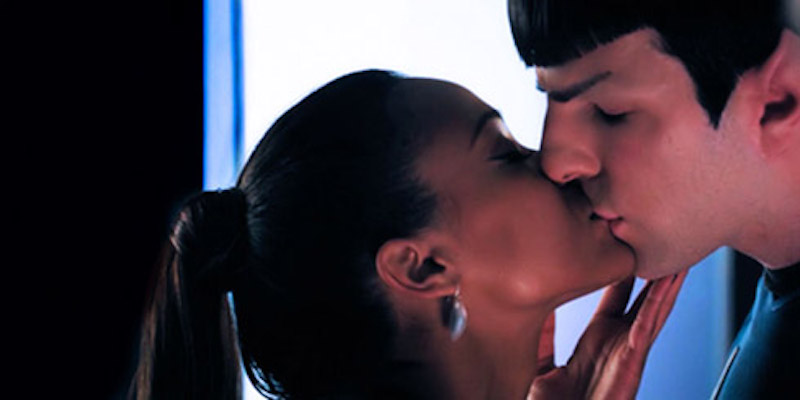
I didn’t think much about the Spock/Uhura romantic matchup in the 2009 Star Trek film when I first saw it. I took it for what it was — a cheeky wink at the series’ established continuity by the people who were in the process of completely renovating that continuity. (On that subject, however: given that Nero’s time traveling misadventures cause no direct change to Spock’s life until about halfway through the film, we can presume that the Spock/Uhura liaison must have occurred in the original timeline as well! Now go watch “Charlie X” again.)
In the years since, though, few collateral pairings in all of SF have fascinated me to quite the degree of Spock/Uhura, or to be more specific, Spock(Quinto)/Uhura(Saldana). (I mean, there’s always Dany/Drogo, but that’s a conversation for another time.) For one thing, pushing Spock and Uhura together is just good old-fashioned shipping of the highest order, cementing Star Trek ‘09 ’s place as terrific fan fiction, among other things. In addition to all the self-referential massaging of Star Trek’s long and illustrious history by a team of geeks who love Star Trek (there’s even a one-off reference to the fate of that awful beagle from Enterprise, fer cryin’ out loud), Star Trek ‘09 boldly gives us two fantastically hot fantasy characters making fantastically hot whoopie with one another, spiced up with that exogamic tang that, according to some, made Spock such an avatar of SF fetishization to begin with. (Theoretically, we can thank Spock — ahem, and Kirk — for the whole notion of shipping in the first place. Well, thanks boys.) And regarding Kirk: it should not go unmentioned that Spock/Uhura represents the long-awaited usurping of Star Trek’s ostensible romantic/sexual lead by the character who, some fans would argue, was always the more alluring fantasy on the original show: the cold, logical, secretly-burning-with-passion Mr. Spock. When Kirk and Spock are heading off on their suicide mission to Nero’s ship and Kirk realizes he is standing alone on the transporter pad while Spock — cold, logical Spock — is holding up the mission by making out with his girlfriend, the white heterodox sexual paradigm of Gene Roddenberry’s original Star Trek finally splits open like a piñata. In my review of Star Trek back in 2009, I lamented its whitebread approach to sex; in this regard, I was dead wrong.
While Uhura (by which I mean the Saldana incarnation of the character) is perhaps not the best-written female lead ever, she’s both a) a substantial improvement over original Uhura in that regard, and b) unfortunately also a substantial improvement over most female leads in most science fiction/action films. She’s clever, for one thing, and her particularly advanced skill with linguistics and communication not only wins her seat on the Enterprise (twice), but identifies the film’s principal threat AND argues convincingly for why Spock would, indeed, fall in love with her. (There’s a kink there, too – Spock, in his role as an instructor at Starfleet Academy, engaged in a romantic/sexual liaison with his best student. Spock?!) Spock, meanwhile, is a cuckoo-bananapants version of Spock in the 2009 incarnation. Where the original Spock had competently mastered his emotional side by the time the Star Trek series was underway (he is only noticeably emotive in the two Star Trek pilots, which might explain what I’m about to say about neo-Spock), neo-Spock is a thinly veiled time bomb of passion and anger wandering the decks of the Enterprise. At the best of times he’s smirking openly at some sort of privately-held joke; and at more critical moments, he’s either openly suffering the death of his planet, or beating Jim Kirk nearly to death for mentioning his mother. This ain’t your daddy’s Spock — nor is it, notably, Spock’s daddy’s Spock. In an abrupt about-face from established lore, Sarek — who opposed Spock’s enrolment in Starfleet and treated his son with contempt for something like the entirety of the next twenty years — instead takes the opportunity of the destruction of Vulcan to tell his son to go with his feelings. If the most emotional scene in your Star Trek movie is two Vulcans admitting in so many words that they’re helplessly in love with their human partners, the paradigm is well and truly changed.
And did I mention that they’re hot? They are. The idea of Spock and Uhura — Vulcan finger-stroking vs. good ol’ fashioned American “doing it” — all intertwined with one another is an SF fetish construct par excellence, for any degree to which it might also seem somewhat out of date in a world where Saldana has already had a different love scene elsewhere which involved tails. While speculating about the sexual practices of our various invented alien species has always been part of the fun, an even bigger part of the fun has — of course — been imagining taming those sexual properties for ourselves. With Uhura repositioned as a no-bullshit action star, and Spock reconfigured with his pacifism left conveniently in his back pocket whenever a ray gun needs firing, we are allowed glimmers of an empowered SF couple who can take on the Klingon Empire together and then go home and fuck for a few hours. (Let the cosplay begin.) But while that’s all dandy, it’s the preternatural tenderness of Spock and Uhura’s actual onscreen interplay – surprisingly resonant, given only a few minutes’ screen time – that has stuck resolutely in my noggin for four whole years.
When Vulcan is destroyed by Nero’s black hole weapon, Uhura is of course the first to rush to (privately) console Spock. It’s a startling scene, all the more so if you didn’t see it coming (in the context of a platonic relationship, Uhura seems to have quite taken leave of her senses when she begins making out with the grief-stricken Vulcan). It’s also deeply tender and is the face upon which a thousand fan-fic ships were likely launched: strength from her, vulnerability from him, and love in the time of apocalypse. Of course, it is Vulcan’s destruction itself which indirectly offers the greatest challenge to Spock and Uhura’s ongoing love affair, although this is never explicitly stated in the film itself (but may play into Star Trek Into Darkness, for all I know): as a member of a newly “endangered species,” to say nothing of a species of highly practical logicians, one can imagine that the notion of any Vulcan breeding with an outworlder would, or could, become a subject of strict taboo. Then again, Spock is half-human, and in the 2009 film comes closer to embracing his human heritage than he ever did in the original timeline (“Earth is the only home I have left”), so maybe he and Uhura can just run off and make quarter-Vulcan babies together. Hybrids are pretty — and those hybrids would be HELLA pretty.
I can’t help, though, but marvel at the extra-textual contours of Spock/Uhura just as much as its in-narrative deliciousness. In the real world, Zoe Saldana is well on her way to cementing her status as the female champion of science fiction on film — lead roles in the Star Trek and Avatar franchises, and now joining the Marvel universe in Guardians of the Galaxy. For all intents and purposes, “21st century science fiction queen” may just as well be a job description newly invented just for her, which also leads to the possibility not only of a woman with sizeable box office clout, but an African American woman to boot. Zachary Quinto, meanwhile, took the opportunity between Star Trek films to announce that he was gay and to champion greater openness in the Hollywood community to help young people identify positive role models for their sexual identities. Saldana and Quinto are, to a fairly vast swath of the under-represented minorities in the entertainment landscape, a fucking Power Couple, even if their coupledom exists only in a made up science fiction universe in everyone’s heads. And while interracial pairings in the media in general and Star Trek in particular are nothing new, there is a nice implicit point in an onscreen romance between an interracial, inter-species couple who are played, offscreen, by a straight woman in a racial minority and a white male in a sexual minority. Basically, in a single throw, Spock and Uhura are a kindly “fuck you” to any long-held bigotries around who people can and should be able to love. If Star Trek remains resolutely behind the times in incorporating queer identities into its vision of the 23rd century, it’s at least become refreshingly on-message in other, valuable areas.