I came to the end of ER the long way around, by which I mean, I dipped from the show sometime while its tenth season was airing (2003-2004) and am concluding its fifteenth season (which aired in 2008 and 2009)… now.
This on the back of a whole-series rewatch which I might have started, no kidding, seven or eight years ago, only really throwing the hammer down on getting to the end after Mark Greene died (again), figuring I’d finally close the loop on the whole series, given that it was, once upon a time, one of my very favourite things.
(That’s the secret wildness of all this, at least to me: In my teens and twenties, I was as obsessive and crazed about ER as you nominally know me to be, re: Star Wars.)
Anyhoo. Once Noah Wyle took the top of the call sheet on ER (!), I was kind of done with the whole thing, which is also kind of secretly wild, given that Carter was ostensibly my favourite character*. Rewatching Wyle’s starring seasons, 9 through 11, and with The Pitt‘s successes firmly in mind, it’s remarkable how unfit to purpose Wyle/Carter seem to be to anchor the show: either because the character was never written for that burden (likely!), because Wyle was just worn out at that point (also likely!), or because ER, as a premise, was grinding its gears trying to find the sauce that initially made the show great (the most likely, I think, of all!).
*There’s a surprise on this score, below.
It’s notable how over-the-top ER becomes in its final seasons — predominantly 12 and 13 — trying to find that sauce, and/or (Andor!) compete with the mid-aughts American television vibe. 24 was ascendant, The West Wing had come and gone, LOST was the biggest of deals, and the unrelenting phalanx of CSI/NCIS/L&O franchises had monopolized the procedural. To keep up, ER seemed to throw an ever-increasing series of improbable pitches at its dutiful cast. There are hostage crises (several, actually) and ambulance explosions (several, actually), unplanned pregnancies and gas leaks. The more they put up the bullet-proof glass, the more likely it is someone will wander into the hospital with an AK-47 and open fire. A main character straight-up commits pre-meditated murder; another loses both his legs after wandering drunkenly into the street and getting hit by a speeding car. One can picture the writer’s room looking at ER‘s shrinking share of the attention economy and imagining a season where they send Luka Kovac to space.
The show settles down again by season 14, but there are offscreen shenanigans crowding the frame then, too. 14 was supposed to be the final season but got banjaxed by the Writers’ strike, so NBC decided to extend the show one more year for its victory lap; all three of its principal actors elected not to extend their contracts, though, so season 15 finds itself balanced on a small handful of recognizable faces. Parminder Nagra is now at the top of the call sheet, but they’ve stopped doing opening credits, so she never gets to do her “look cool and lean back on the chair” shot. They promote Uncle Jesse and Chad McCann, The Coolest Boy In School, to lead roles, which almost works. The fifteenth season is eked out by a fairly deft crop of med students and interns (“This is a teaching hospital!!” we all yell in unison), brought in to carry some of the original, Carter-ish vibes of the show.
(I’d be remiss if I didn’t also mention the sudden arrival of New Main Character Dr. Simon Brenner, an Australian expat played by David Lyons. House had an Aussie, so I guess ER felt they had to get one too. Brenner isn’t the only character whose brief stint on the show is wall-to-wall bizarre — the sleep deprived, strike-addled writing staff also converts a married couple into siblings at the season’s midpoint, which is exactly as confusing as you’d think — but the season’s focus on Brenner is maybe the show’s biggest whiff on a new member of the team since Lucy Knight. He’s introduced as a philandering nepo baby with near-sociopathic empathy issues, then switches to a lovelorn, puppy-eyed sadboi before vanishing off into a childhood sex abuse trauma storyline. Brenner is the only part of this entire show I’d probably fast-forward through if I ever watched the series again.)
It’s all a weird brew, especially given that this mixed bag of lead characters is intended to anchor a final season that brings back as many of the emeritus cast as possible, including Mark Greene (he died!), Rocket Romano (him too!), and George Clooney, the 800-pound-gorilla whose character was alive but who had remained respectfully offscreen for over a decade. It’s a friction that actually ends up underlining a key point: except for a couple of the nurses, no one is left at Cook County Hospital who remembers the original cast of this show at all. Time — relentless — hasn’t just marched on; it’s severed the threads that tie the present to the past.
ICE starts showing up. The iPhone shows up. What we, in 2026, might recognize as the start of the Modern Era — Obama giving way to Trump; liberal democracy giving way to GamerGate — starts foxing the edges of the last dozen episodes of ER. And what was once the nineties’ defining champ of procedural television ducks behind the curtain, just before the ignominy of the ’10s begin, collapsing everything the ’90s thought they stood for.
And finally, for the last time, John Carter returns.
Carter in pain
Here, too, we might get a whiff of the future. Noah Wyle’s back on ER for its final six episodes, and it’s as committed and nuanced a performance as I’ve seen him give since, at a guess, at least season 8. I’m overall leery of connecting Carter to Dr. Robby and ER to The Pitt — it’s too facile, for one thing — but here I think we see a bit of the creative project that Wyle is becoming invested in, which will fully inform the creation of Dr. Robby. We begin to see it because here — more than ever — Carter is a quivering, weary ball of repressed pain, and he is absolutely refusing to deal with his shit.
(Historical note: I am writing this between episodes 11 and 12 of The Pitt‘s second season. Now, I doubt Dr. Robby is actually going to kill himself, or even overtly try, before episode 15 rolls. But boy, he sure seems like he wants to.)
Wayyyyyyyyy back in season 6, Carter got stabbed. You’ve probably heard of it. A couple of things fell out of this. Firstly, Carter became addicted to painkillers. This formed what turned out to be the hinge point for the character, and certainly seems to have been the dramatic material that Wyle was best at / most invested in playing; it redirected everything about the character afterwards, even once Carter has faced his addiction and moved forward. The Carter who takes ownership of his privilege and begins to apply himself to more and more demanding medical crises seems to grow directly out of this reckoning. (And, not to go back to the Pitt of it all, but this storyline gives Wyle’s scenes with Patrick Ball’s drug-addicted Dr. Langdon a funhouse-mirror tension of their own.)
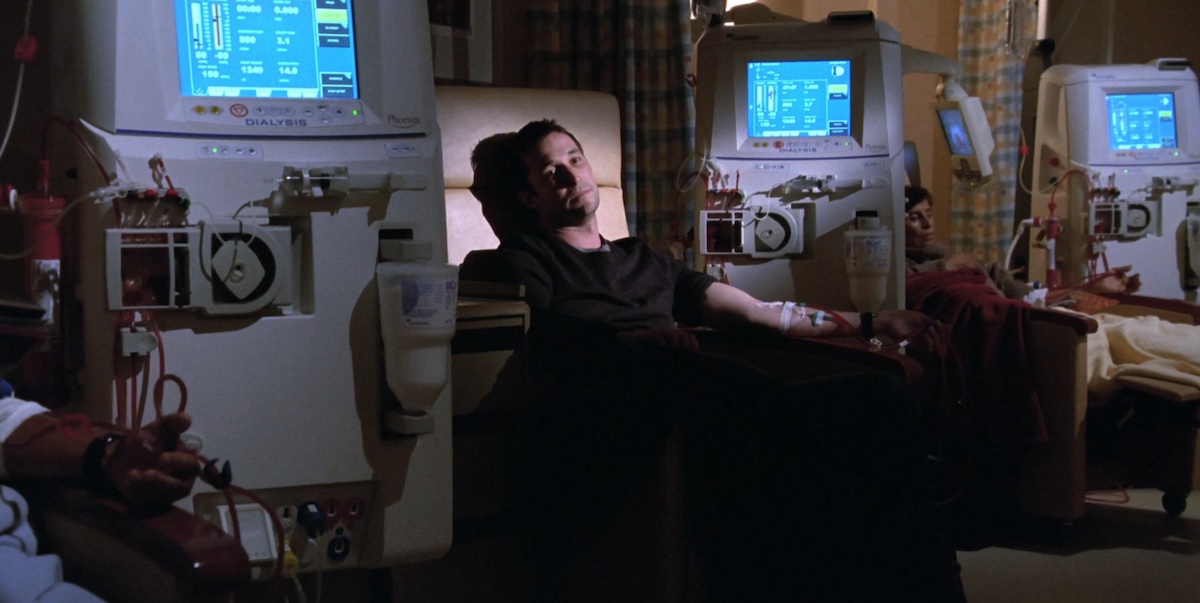
Second: Carter got stabbed in the kidney, so he’s only got one. And now the other one is starting to fail. So he’s back at Cook County in the tail end of season 15, sitting on the transplant list, separated from his wife, not telling anyone what’s going on with him, and basically feeling sorry for himself. It’s great, rich stuff.
It also — amid a generally low tide, I’ll admit — leads to one of the best episodes ER ever produced, just four from the end: “Old Times,” in which a cross-country organ donation trip for Neela and Sam gives the show an excuse to loop George Clooney and Juliana Margulies back into the fold for their victory lap, while Carter waits for a kidney in Chicago with another surprise guest star, Eriq La Salle*.
*And this was it. This was the moment I realized that La Salle’s Peter Benton might actually be my favourite ER character of all time, so huge was my whoop when that beautiful sumbitch walked through the door. He saves Carter’s life in surgery — again — of course. And I will note that in Wyle and La Salle’s final scene together, in the very last time Benton addresses his former student by name, he calls him John — for what is, I believe, the very first time. 🥹
Look, “Old Times” is nostalgia porn par excellence (and coming out as it did in close proximity to both Live Free or Die Hard and Indiana Jones and the Kingdom of the Crystal Skull, we could call it one of the early prototypes of that media trope that has subsequently overtaken Hollywood, the legacy sequel). But Clooney — who probably shot this episode on a weekend off between Michael Clayton and Up In The Air, if you need a refresh on exactly how dominant he was in Hollywood mid-scale drama in the aughts — is superb, slipping so effortlessly into Doug Ross’ subharmonic purr that every pleasure sensor in my brain fired at once. “Old Times,” indeed. These are some comfortable old shoes. Seeing Doug with Carol all these years later, matters. Seeing Carter and Benton giving each other shit again, matters. (Benton’s grinning disbelief at Carter, the whitest character in the history of television, having married a Black woman is wonderful.)
But none of this would put “Old Times” in ER’s best-episode bracket if not for the way series producer John Wells — writing and directing for the show for the final time — uses the story to sketch a national medical community in gathering crisis, but still working hand in hand to save lives. Carol is coordinating dozens of transplant surgeries from Seattle, where doctors are waiting to bring their harvested organs home; Susan Sarandon guest-stars as the grandmother of a teenage boy who has been hit by a car and is now brain dead, who must choose radical acceptance of this devastating loss before any of the doctors can carry on their life-saving work. Neela and Sam reminisce about County with Doug in the break room; none of the people Doug knew (except Anspaugh) are still there, and Doug and Carol never find out that one of the organs they’re working so hard to procure — the kidney — will go to Carter. (“Some doctor in Chicago,” Carol tells Doug later.)
Then Wells anticipates the most moving sequence of Rogue One by half a dozen years, as the donor organs move from hand to hand and place to place, until they finally find themselves in the care of the transplant doctors who (not without some drama; this is ER, after all) house them in their new bodies. In doing so, they save the lives of both a mother of a young girl (Ariel Winter as the latter, immediately prior to Modern Family) and, of course, John Carter.
Who finally calls his wife, because this, too, is the meaning. Not “every day could be your last,” but rather, “every day is this struggle.” How we face it, and who we face it with, matters. Some medical shows are more explicit about their theme, some less; some aren’t built to the purpose in the first place, and ER probably wasn’t. But here, Wells signs the show with a deft hand, even drawing the ship of Theseus of its cast members, the end of which can’t remember the beginning, into his final argument. This was at the heart of it all, these hands passing hope to hands. We are all of us in a continuum, one being to the next. We make the struggle worth it together. It’s better when we do.
Multimorbid
My dear friend Rebecca Wood’s first book, Multimorbid, is now available through Kith Books, a label I really like. (I mean I would have supported the book if it was stapled to the inside of a used pizza box lid, but, I digress.)
Through poetry, prose, and clever wordplay, Multimorbid details the frustrations of seeking, asking for, and receiving care. Wood speaks to the mental toll of chronic illness (“Thoughts poisoned feel/are/feel true / Evidence of competency, capacity, capability / trapped behind glass”) — even as she is interjected by the people who love her — her lines blur between dis-ease and defeat. Multimorbid’s oftentimes darkly comic take on disability leaves everyone complicit and a little bit scarred — care teams lost in the red tape of their own ‘efficiency’; friends and patients alike, trying and failing, and doing their best. And the patient — too patient — advocating, explaining, (self) soothing again.
Weirdly on-theme for today’s issue, actually.
Get your copy here. Shipping in May!

In other news
- Speaking of Michael Clayton, Tony Gilroy’s thriller is coming to the Criterion Channel in April, which (in my useless mind) puts us one step closer to Criterion doing a proper 4K release of the film on disc. (Criterion.com)
- Surprising no one, ParaBroSky has killed Star Trek, again. Surprising everyone, Disney has renewed Wonder Man?! (Deadline)
- Much faster than I could have expected or hoped, Stranger Things is coming to 4K disc this summer. Anyone want to tip me, like, roughly US$230? (Arrow Video)
- Still modestly, ambivalently in my feelings about the Buffy/Nova show getting canned, I have dialed in to The Lowdown (because Ryan Kiera Armstrong is on it, among other reasons) and, well, yeah, that’s exactly as good as everyone’s been saying. First episode is so great. Second episode is a god damned masterwork. Shows!!
- I used this Dune font generator to immortalize what Daniel Cockburn and I agree is the best 8-word line in Marty Supreme. I dunno, maybe you can come up with better uses for it. (Pixelframe)